
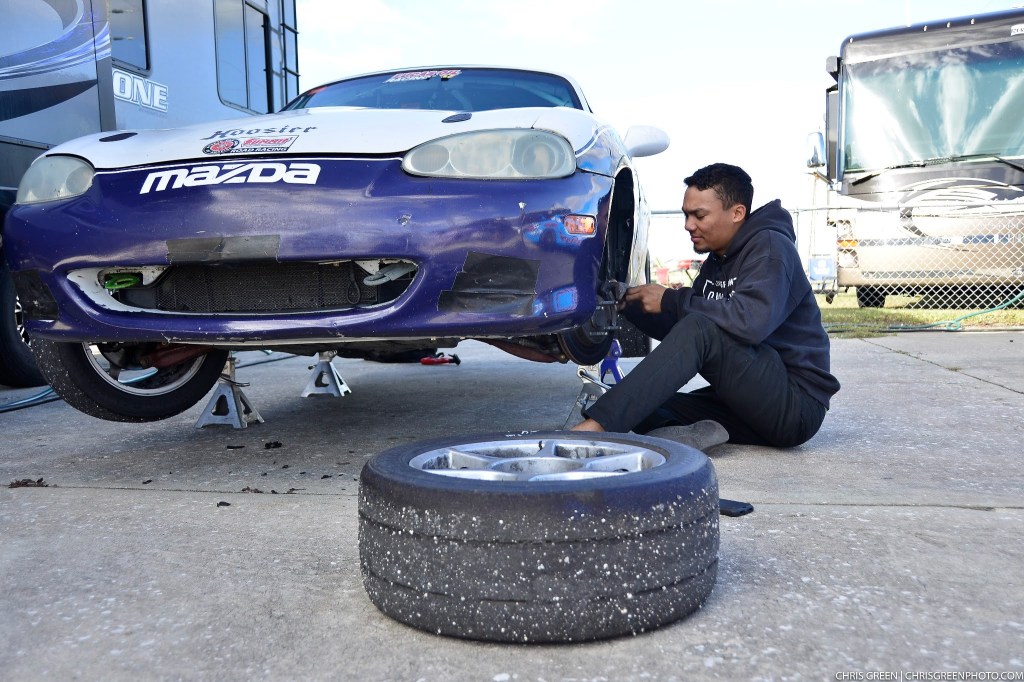
Photograph by Chris Green.
The following interview was conducted over Zoom and edited for length and clarity. All photos credited to their respective photographers.
Brad Perez grew up in Miami watching NASCAR as a fan before he understood any of the culture around it. He was five years old for his first race, the 2001 Daytona 500, the one where Dale Earnhardt died. He didn’t know yet that the sport he loved was considered, in the world he grew up in, something you weren’t supposed to like.
He built his way into professional racing without a karting academy pipeline, without family funding, and largely without anyone showing him how any of it actually worked. He taught himself to wrench on cars so he wouldn’t have to pay someone else to. He split the cost of his first race car with his dad. He has interned and worked his way through NASCAR, IMSA, SCCA, and NASA teams, and today he races in the O’Reilly Auto Parts Series and ARCA while instructing at the BMW Performance Center and Monticello Motor Club to keep the lights on.
He is 29, first-generation Puerto Rican and Dominican, and millions away from a full-time seat.
This is his story.
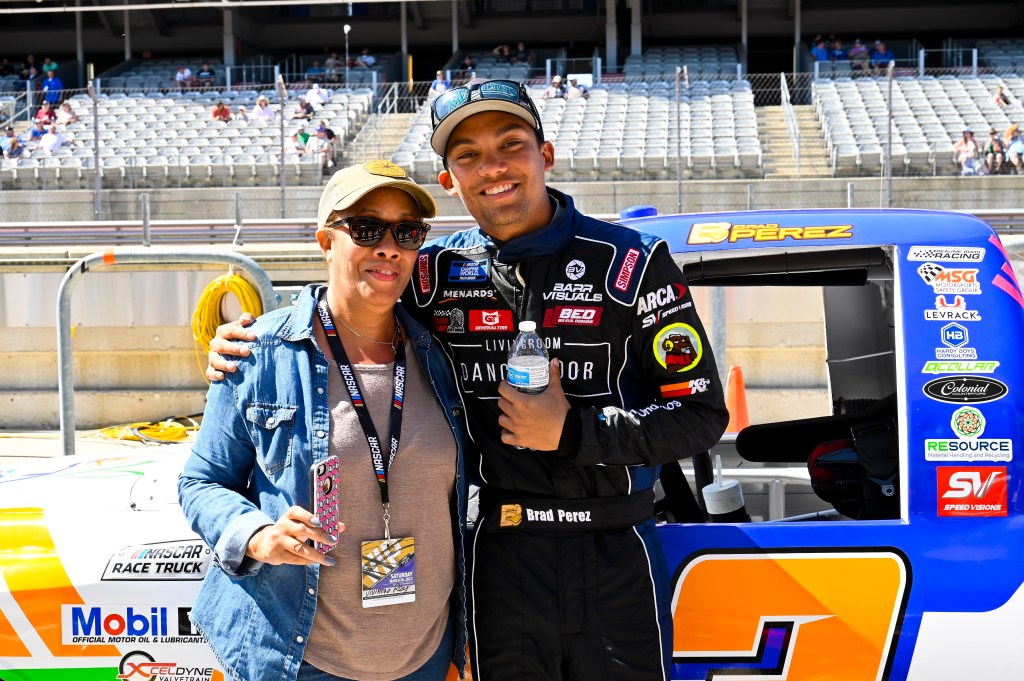
Photograph by Daylon Barr Photography.
Part One: Origins and Identity
IRC: You’ve talked before about being a first-generation Puerto Rican and Dominican racer. What did motorsport look like from the outside when you were a kid?
Brad: I grew up in Miami, and the only way I knew the sport was as a fan. I started watching when I was five, and unfortunately the first race I ever saw was the 2001 Daytona 500, the one where Dale Earnhardt died. So my frame of reference was pretty limited from the start. I didn’t understand the culture, and I definitely didn’t understand what these people were talking about. All that resonated with me was, wow, cool, bright car going fast on a track. That’s what got me. It took a while to actually grasp what it all meant, and I mean that in terms of the financial sacrifice it takes to do something like this. I think I understood that piece by the time I was ten. I also didn’t realize, just from watching cars on a track, that NASCAR is inherently a Southern sport, and everything that comes with that.
As my interest grew, at school and with my friends, I was the only kid who cared about NASCAR or racing at all. People called me a redneck, which is about the furthest thing from what I was. I got ostracized for liking it. Looking back, it’s funny, because differences are supposed to be a good thing, but I grew up in a school that was mostly Black and Hispanic, with fewer white students than Asian students and even fewer Asian students than either of those groups. It was a real melting pot, but I didn’t realize how much of a rift it created that motorsport fell outside of it too, like it was one more thing I wasn’t supposed to like. That’s what I grew up knowing: I like this weird thing that apparently nobody else likes, and I don’t know what to do with that.
It’s different now. I see kids online from my own neighborhood who are into NASCAR, and I think, where were you? But I do think the sport has become more accepting and more universal than it was in the early 2000s and late ’90s.
IRC: You’ve shared in the past that you played baseball before becoming obsessed with motorsport. What are some lessons you’ve learned from baseball that apply to being a driver today?
Brad: This is more about my personal experience than baseball in general, but I felt like I was naturally good at it, and I honestly attribute a lot of that to my heritage. My dad played college baseball in the Dominican Republic. Being Dominican and Puerto Rican, baseball is just what you do. It’s part of the culture. I was naturally good enough that I didn’t really have to put in the work. My dad wanted to put the work in for me because he cared, but it was hard to tell him I didn’t feel that drive myself. Still, I knew it was the best thing for me, so I kept trying, at least enough to stay happy doing it.
Once I got to high school and into the competitive Florida baseball scene, playing against guys who went on to the majors, like Manny Machado, I actually had to dig in. Nobody could just tell me to get better; I had to put in extracurricular effort on my own to be the best I could be. I didn’t fully know it yet, but that turned out to be exactly what racing would demand of me, just at a much higher level. My entire life now is built around being self-motivated, because if I’m not, nobody’s doing that work for me, and I just fail.
IRC: Was there a specific moment you remember deciding driving wasn’t just a hobby, that you were actually going to try to make a career out of it?
Brad: That probably came from karting. I started at K1 Speed, and I didn’t even have a real go-kart. That was me testing the waters, figuring out if I was actually competitive or just having fun. I did the K1 Speed League and did really well. I started asking myself, am I good because I care, or am I good because everyone else is bad?
Then I got an opportunity to race a go-kart locally in a more professional setting. I qualified badly in my first race because I had no real experience, and then drove from last to third. I remember thinking, okay, maybe I should actually care about this. Maybe it isn’t just fun anymore. Sometimes you need to scare yourself into believing in yourself. Up until that point I believed in myself apathetically, like this is what I want to do to have fun, but there’s no way I could actually be good enough, not with kids my age already racing ARCA. After that race, I thought, wait, I am good. Maybe I should really try.
IRC: How do your family and community talk about what you do now? Has that changed as you’ve moved up?
Brad: It took a lot of education. The barrier to entry in this sport is bad, and it’s not just the money, though that’s obviously a huge part of it. The information gap is even bigger. There are so many small nuances to racing that are hard to explain to the average person, let alone someone who’s never been to a racetrack and doesn’t speak the language of it at all.
Starting out, I was working for a really underfunded backmarker team, terrible hours, terrible pay. People in my life would say, why are you making that kind of money, you could go work at Chick-fil-A and make more. Or, is your team like the ones that race against Jeff Gordon? And I’d have to explain, no, we race on Saturdays, and we don’t really win. People would ask why I was even part of it, and I’d say, if it were easy, I’d already be doing it. I’m trying. A lot of it was education at first, and it wasn’t that people doubted me exactly, but they’d hear what I was doing and wonder what made me think it would work out for me.
I had to shut that noise off for a long time and just get myself to a point where the results spoke for themselves. Once I was actually racing, people came around. And you can’t really be mad about the early skepticism, because a lot of my family and community hadn’t seen anyone who looked like us, or who had the kind of money we had, do something like this. They were trying to protect me. But I was willing to make that sacrifice, because I understood what would happen if I failed: I’d move back home, find another job, save up again, and start over. I had the privilege of being able to take that risk, and I took it, because why not.
IRC: A lot of interviews focus on your racing resume. I’m curious what it felt like to be one of very few people who looked like you or came from your background in the paddock, especially early on.
Brad: At first it was intimidating, because you don’t really know what to expect. I think a lot of people of color, and women in general in this sport, get in and immediately have to put their identity aside just to operate in that space without feeling like a sideshow. I’m not saying we don’t belong. But it can feel that way. When I first got to SCCA events, I tried to think of myself as just someone trying to race, being as easygoing as possible with everyone, code-switching however I had to, just to make sure people were comfortable and I was building relationships. It was hard to find my kind of people. Doing that taught me how to navigate those spaces, what to say, what not to say, what to hold back.
It sucks a little, honestly. You don’t go to the park to play basketball and have to hide your personality to do it. You don’t play soccer and have to diminish who you are. And there just weren’t many young people at the track in general, and the ones who were there usually came from families who could afford an RV and a stacker trailer. I couldn’t relate to that financially at all, and it did feel lonely sometimes. But over time, as I met more people, I realized I wasn’t as different from them as I thought. And in a way, I got to teach people things they wouldn’t have known otherwise, and they taught me things too.
Part Two: The Unconventional Path
IRC: You didn’t come up through a karting academy pipeline. You built your own Spec Miata and worked your way in through internships at NASCAR, IMSA, SCCA, and NASA. Walk me through why you took that route instead of waiting for an opportunity to find you.
Brad: I try to break things down as simply as possible and not overcomplicate my own situation. At the end of the day, I needed somewhere to stay, and I was living with my parents. The only reason they let me stay was because I was in school and working. So I figured, if I can go to school and work, and find a way to race on top of that, it could work. But if something went wrong while I was racing, I didn’t have anyone to bail me out financially. That’s part of why I got into networking with NASCAR people early, mostly through racing online before iRacing really took off.
Living at home meant I didn’t have overwhelming bills, so I could focus on learning. I’d go to a shop and learn how to wrench on someone’s car in exchange for the opportunity, instead of paying for trade school, which I couldn’t afford anyway. I was also in school for marketing at the time, trying to figure out how I’d fund all of this. It didn’t all work out exactly how I planned, but the idea was: get internships to learn how to work on cars, so when I finally had my own car, I wouldn’t have to pay anyone else to maintain it. Then find sponsorship to buy the car in the first place.
I wasn’t going to get the seat time the karting kids got, so I wasn’t going to be competitive for those academy scholarships. I was already too old by the time I started karting, 17 or 18. I even tried out for NASCAR’s Drive for Diversity combine and was told I didn’t have enough experience. So the only way in was to learn how to wrench myself and figure out, piece by piece, how to get there without a race car to start with.
IRC: What’s a part of your path that people don’t ask about, but that you think mattered more than they realize?
Brad: How to find the money. That’s such a huge hurdle, and I think part of the problem is that people gatekeep how to actually do it. There’s a lot of smoke and mirrors: people say, I worked so hard and I did all these things and I got this opportunity, and I’m like, no, you didn’t get an opportunity. Nobody just gets an opportunity. It presents itself because you did this, this, and this, and then you still had to figure out how to pay for it.
I’ll be fully transparent about what that looked like for me. My dad’s job covered the gas in his work truck, so we had gas to get to the racetrack. We borrowed a U-Haul with a spare wheel to haul the car. I split the cost of the car with my dad, nine thousand dollars. Tires were another thousand. The entry fee was $850. I’d try to find sponsorship in my off time, but most of what I earned at my job went straight into the car, not into going out or vacations. My phone bill, tires, parts, an iRacing subscription, that was basically the extent of my expenses, because I didn’t have rent to worry about living at my parents’ house. If I’d had to pay my own bills on top of that, there’s no way I could have afforded it. Even now, if I wanted to run Spec Miata on my own money, I’m dropping close to two thousand dollars every time I go to the track. Even racing NASCAR, I still can’t just drop that kind of money whenever I want.
That’s the part I wish got talked about more, because I think it’s what scares people away. If people understood the actual cost and could plan around it, sometimes they’d find that others are willing to help. I’d get take-off tires from people at the track who only needed them for a session or two. I learned how to use a tire iron myself. I’d buy a dinged-up set of wheels off someone cheap and mount them myself on race day. Little things like that. I wish more people knew that side of it, instead of just seeing the version where you rent a ride from someone and it costs a fortune, and thinking that’s the only way in. I’ve talked about writing a book laying out everything people in my position should know to make it happen. I probably should.
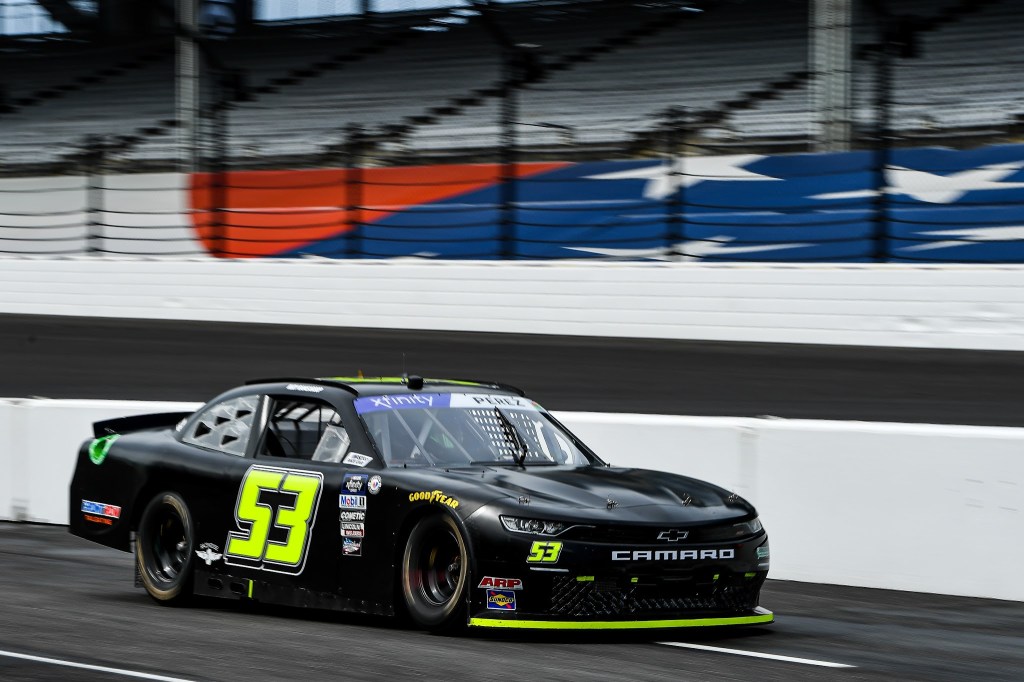
Photograph by Nickolas Wolf.
Part Three: Racing Today
IRC: You’re currently racing in the O’Reilly Auto Parts Series and ARCA, and instructing at the BMW Performance Center and Monticello. What does a season actually look like for you, logistically and financially, compared to what people assume?
Brad: It’s a mess. A NASCAR license, the hard card, runs around $3,600, and you have to sign up for it in January, when I never have that kind of money sitting around. I barely have two grand to spend, let alone $3,600 for a piece of plastic. So usually I’ll go to a team I’m planning to eventually drive for and say, here’s some races I’ve already sold or have lined up to sell before the season starts, can you lock in my hard card for me, and I’ll work it off. Whenever they need shop help, I’m available, unpaid, because that’s the trade.
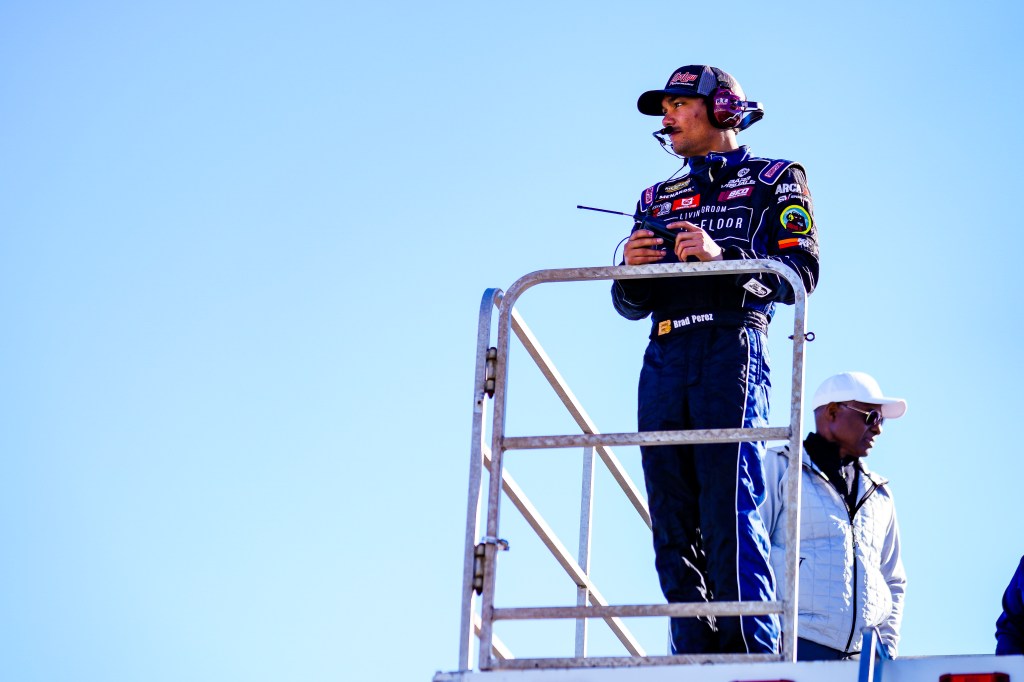
I don’t work every day, because I’m juggling about five part-time jobs, and none of them coordinate their schedules with each other, so I still end up broke half the time. But I keep myself open for it. On weekends I’ll go on the road helping a team, and on weekdays I’ll book myself to instruct at BMW or Monticello, which pay anywhere from $330 to $800 a day depending on the manufacturer. If work is slow for a couple of weeks, I can fall back on that or pick up a week at someone’s late-model shop. When we’re at road courses, I’ll double dip, spotting the Cup race, spotting the Truck race, and racing my own O’Reilly race, which can add up to about $2,000 for the weekend on top of driving. It’s a lot of grabbing sporadic work throughout the year, saving what I can, and spending the rest of my off time chasing sponsors, managing logistics, and handling the social media side of things, none of which pays anything directly.
IRC: Sponsorship and funding are a constant conversation as a driver. What’s it like to build partnerships as someone without a traditional pipeline or family funding behind you?
Brad: The one thing that’s stayed consistent is that people don’t sponsor you because of what series you race or what the car looks like. If that’s the only reason someone signs on, they’re probably never going to talk to you again after the check clears. People have to like you for you. They have to resonate with your story and what you stand for, even if it’s not a perfect match on everything. All of that plays into whether someone wants to actually support you long term.
It’s easy to lose sight of that chasing a quick deal, whether it’s forty grand or ten grand. I can’t take on a bunch of small sponsorships at once, because I don’t have the bandwidth to make sure everyone gets a real return, and I don’t want to take someone’s money and not deliver. I’d rather be upfront about exactly what I can offer than overpromise and burn the relationship. Because of that, I’m grateful for the partners I do have who stick around. Some of them are genuinely good friends at this point. They know me, they know I’m busy, they know I’ll try for them, and if something doesn’t come together, it’s not because I didn’t care or didn’t try.
Honestly, I’d rather have twenty partners giving me ten grand each than one giving me a hundred grand who’s a headache to manage, because I can’t provide what that kind of relationship would demand. It comes down to figuring out what you’re actually willing to take on, and how much work you can realistically put in. It’s a bit like matchmaking. Here’s who I am, here’s who you are, does this actually make sense long term, or are we just going to waste each other’s time.
IRC: Is there a race or a season that tested whether you wanted to keep going? What kept you in it?
Brad: I remember this one very vividly. I want to preface it by saying I think about quitting every single day. I wake up and think, I don’t have to do any of this. I could just work for BMW and not deal with any of it. I have free will. But I still show up.
It was 2023, Indianapolis, and I was working for Emerling Gase Motorsports. I’d sold four races at the start of the year to three different sponsors, which felt like real progress, like I was finally diversifying. Two of my teammates hated road courses, so I figured I could fill in for those. I didn’t sell all of the road course races, thinking either the team would find money elsewhere or I’d get the call. Sure enough, the owner called me that Tuesday, with the team leaving Thursday, saying they needed me to drive Indy. I was thrilled. I didn’t have to pay for the seat.
It was still a grind. We were down to three of us working on the car, the crew chief, the car chief, and me, and since I was driving, we were short a hand in the shop too. We’d driven ten hours to get there. Practice was rained on, which made me nervous since I hadn’t been in the rain in a stock car in a while, but we ran well and qualified into the show, sending a few faster guys home in the process. I felt like a pro. Then I went up for driver introductions, and the person running the stage didn’t recognize me and skipped right past my name. My first time at Indianapolis Motor Speedway, and I missed my own intro.
I got back to the car, and there was no sponsor there, no crew beyond the car chief and me. During a red flag for a tire change, I realized we didn’t have our tools, our crew had forgotten the jack and the gun, so I borrowed equipment from a pit crew nearby and jacked the car myself while the car chief changed the tires. I drove from last up to around 31st, passing nine cars, and then the brakes went. I nearly hit the wall, and the car caught fire near turn one. I got out and thought, I have to drive ten hours home now. I was done. I remember thinking, what is the point of any of this. Every August since, I think about that day.
My teammate, Alex Labbe, finished eleventh that race, the team’s best finish of the year, in part because the car I’d helped keep on track all season made it possible. It’s wild. But that was one of the moments where I realized how much I could actually take, and somehow I was still there the next weekend.
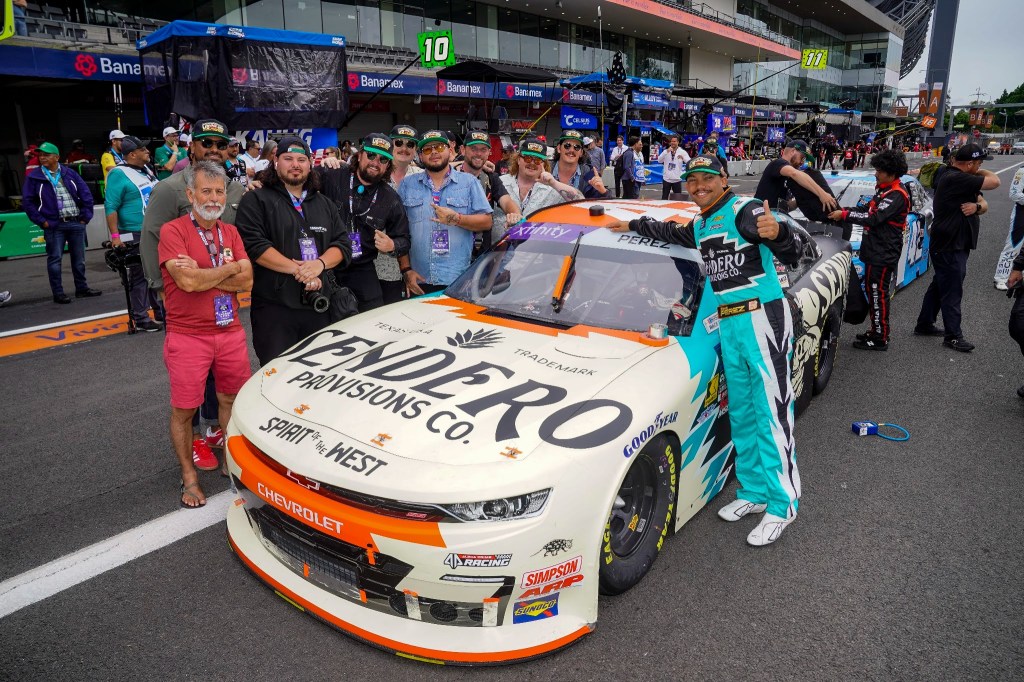
Photograph by Daylon Barr Photography.
Part Four: Representation and What Comes Next
IRC: In Racing Color exists because we think the people who’ve always been in motorsport haven’t always been the ones telling its stories. Where do you see yourself in that? Are you thinking about your career as part of something bigger?
Brad: I’m past the point of measuring this by personal accomplishments. I’ve been through enough that winning the Daytona 500 or a Cup championship just doesn’t feel as significant to me anymore in the grand scheme of things, and I’m okay with that. What matters more to me is that my parents worked a dual-income household in the suburbs of South Florida, my mom a nurse, my dad an electrical contractor, neither of them owning a business, and I’m still able to do this. It took a lot to get here, but I want kids in that same predicament to know they don’t need parents who own a business or generational wealth to find a path in. If you really want it, there is a way, and I want to help outline that path better for more people.
Eventually, if I ever have the means, I’d like to build something, not exactly a scholarship fund, but more like a team that helps people try different roles in motorsport, not just tell them what fits them, but let them find out for themselves. Driving, PR, sponsorship management, engineering, whatever it turns out to be, without requiring a trade school certificate or a communications degree first. That kind of thing doesn’t really exist yet, and it’s concerning, because there’s so much money and opportunity in this sport already. I’m glad programs like Rev Racing and NASCAR’s Drive for Diversity exist, but even with those, there’s still nothing that lets people build real experience on their own terms, without needing a pile of money or a traditional degree first. I don’t want my story to be the only story like this. It doesn’t sit right with me, and honestly, it makes me feel more alone in my own industry than it should.
IRC: Have you had drivers, or kids, reach out to you specifically because they saw someone who looked like them or came from where they came from? What do those conversations look like?
Brad: I get a lot of those messages, and I feel bad, because I can’t respond to all of them. The ones I usually do answer are from kids who’ve already put in some work themselves, who’ve put themselves in the rooms and situations where I’m not starting from zero explaining everything. A lot of it comes down to money: how do I find it, how do I find the people who have it.
The honest answer isn’t something I can just say publicly without it sounding wrong. You have to go to the racetrack, find people who have money, and understand how they operate and why they do what they do, and be genuine about it, not just show up looking for a check. There’s a fine line, and it’s a real disadvantage for kids who are introverted or have ADHD, because that kind of relationship-building isn’t easy to teach. A lot of the kids I talk to get too nearsighted, thinking if they just win a go-kart championship, they’ll get noticed. That’s not how it works. You can win a go-kart championship and nobody will care by the next morning. I want to help every kid who reaches out, but I don’t have the means to, and honestly I don’t have all the answers either. I’m 29. I’m still figuring a lot of this out myself. I’m not a sensei.
IRC: What do you wish someone had told you when you were starting out, something more specific than the general “keep grinding” advice?
Brad: Honestly, I feel like whatever wasn’t told to me, I just had to learn the hard way. Maybe I’m hardheaded and needed to suffer through it to figure it out. But if I had to pick something, it would be: don’t be so hard on yourself. It’s okay for things not to work out. Every phone call, every yes or no, used to feel like life or death to me, like the window was closing and I was running out of time. I’m a lot more at peace with setbacks now than I used to be. I used to think my life was ending every time something fell through.
I think if I hadn’t based every decision on stress and fear, I would have actually enjoyed the journey more, and maybe things would have gone better too, because I wasn’t operating from such a negative place all the time.
IRC: Where do you want to be in the next two or three years, and what’s the biggest thing standing between you and that?
Brad: I want to be a full-time competitor in the O’Reilly Series. Realistically, I’d broaden that to any full-time series. I love IMSA, I love sports car racing, I love all of it, but the O’Reilly seat is the most realistic path for me right now. What’s standing between me and that is $1.4 million. I don’t think it’s impossible. I feel like I’m as close as I’ve ever been, even though I’ve probably said that in my last ten interviews. I think it’ll happen.
I’m not really afraid of failure anymore, and I’m not afraid of hearing no. At this point it’s more a question of how much of my life I want to give to it. I don’t want to miss birthdays. I don’t want to miss out on things that matter outside of racing. I care about this deeply, but I care about being a person first. I’m not enough of a sicko to give every single part of my life to it, but I think it’ll happen soon.
IRC: Is there a favorite quote from a driver you’ve met that guides you?
Brad: It’s from Andy Lally, a driver who’s pretty self-made, and someone I respect a lot, a hero of mine, honestly. He told me: in racing, you can do whatever you want, but at the end of the day, you have to put yourself first. If you can put yourself first, everything else will fall in line. It’s a little ironic, since racing is literally about being first. But it applies to business too. You have to think of yourself first, and then for the betterment of everyone else, because if you put yourself third, it might not even be the best outcome for the people around you either.
A Note From Amanda
Brad told me early in our conversation that he’d read Samantha Tan’s interview before he knew it was mine, before he made the connection that the person reaching out to him was the same person behind it. That stuck with me through the rest of our call, because it’s exactly the thing In Racing Color is supposed to do: get passed around by people who see themselves, or someone they respect, in it.
What struck me most about talking to Brad wasn’t the résumé, the NASCAR license, the internships, the O’Reilly seat. It was how specific he got about the actual mechanics of getting there: a nine-thousand-dollar car split with his dad, a borrowed jack at Indianapolis, take-off tires scavenged trackside. He kept circling back to the same point. Nobody just gets an opportunity. Somebody pays for it, one way or another, and figuring out how is its own skill that nobody hands you a manual for.
He also talked about wanting to build something so his story doesn’t have to be the only one like it. I believe him. In the meantime, he’s still $1.4 million away from the seat he wants. I have a feeling he’ll get there.
Brad, thank you for trusting me with your story.
— Amanda
Follow Brad across his platforms:
- Instagram: @uhbrad
- Website: https://bradperez.com/
- Twitter/X: @bradxperez
- Facebook: BradPerez
In Racing Color publishes interviews, profiles, and essays about the people who make motorsport what it is, with a focus on the voices that have long been overlooked. If you’d like to be featured, collaborate, or simply follow along, you’re in the right place. Find us at @inracingcolor on Instagram and Threads.


Leave a Reply