
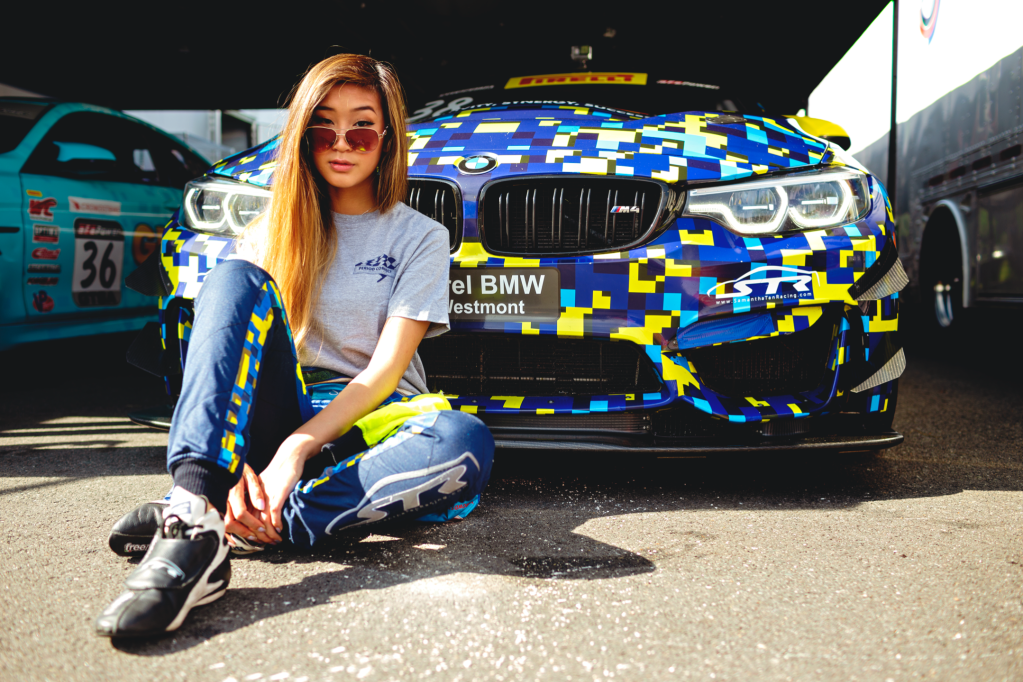
Photograph by Sean Krinik.
The following interview was conducted in writing. All photos credited to their respective photographers.
Samantha Tan grew up in a small town north of Toronto called Gormley, one of the only Asian kids in her school from kindergarten through Grade 12. She came to motorsport through her father, who gave her more than an introduction to cars. He gave her a framework for how to pursue something that felt impossible.
She has been doing it ever since.
At nineteen, she co-founded ST Racing alongside her father, building the team while simultaneously developing as a driver. She has competed in GT4, GT3, the 24H Series, the Nürburgring 24 Hours, and IMSA VP Racing SportsCar Challenge, where she claimed her first GT3 championship title in 2025. BMW named her their first female POC GT3 team owner. Last year, she raced at Road to Le Mans.
The full 24 Hours is still the goal. She sees it clearly now.
This is her story.
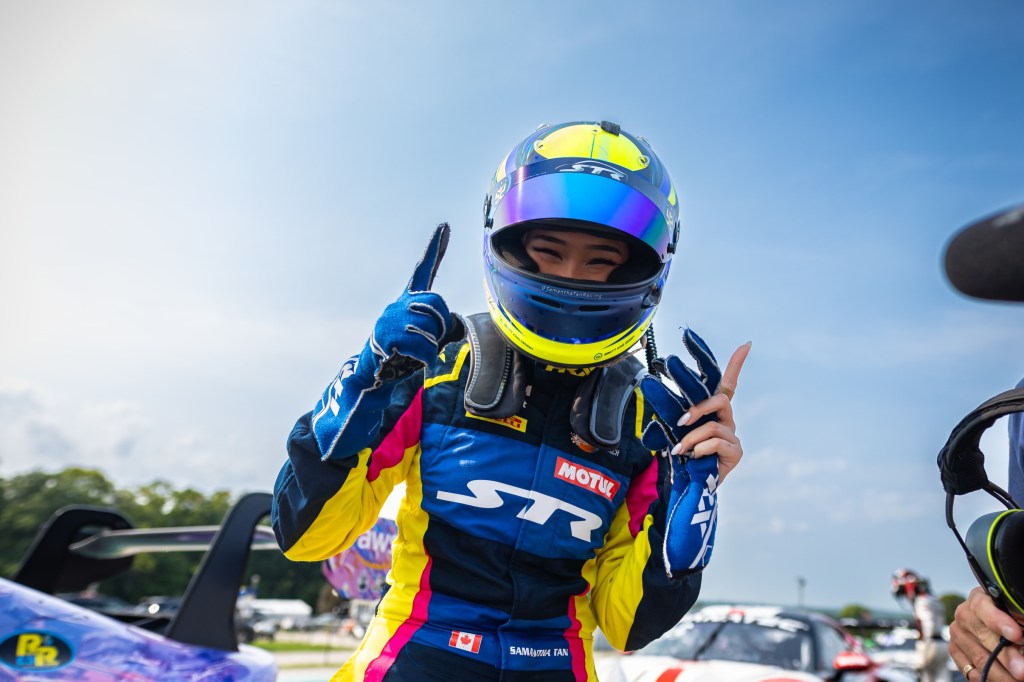
Photograph by Fabian Lagunas.
Part One: Where It Begins
IRC: Before the racing career and everything that followed, tell us about home. What does growing up Canadian and Asian look like in your memory? Is there something you still carry with you today?
Samantha: I grew up in a very small town north of Toronto called Gormley, and when I think about home, my first memories are actually incredibly warm and quiet. My childhood was filled not only with my immediate family, but also my aunts, uncles, cousins, and grandparents, who all played a role in raising me. We were constantly surrounded by love, conversation, food, and family.
Life itself felt relatively simple back then. I spent so many afternoons outside running around our backyard, exploring nature, riding my bike around the neighborhood, at least whenever I wasn’t preoccupied with Kumon homework or after-school piano lessons, which I think every Asian child can probably relate to in some capacity.
At the same time, outside of my family, I had very little exposure to the Asian community growing up. My brother and I were some of the only Asian kids in our school from kindergarten all the way through Grade 12. When you grow up constantly aware of being different, you learn very quickly how deeply children just want to fit in. I think, for a long time, I subconsciously rejected parts of my culture because I wanted life to feel easier. I wanted to blend in.
There’s a strange kind of loneliness in growing up without seeing your identity reflected around you, because you begin to internalize the idea that belonging is tied to proximity to sameness. But despite all of that, there were always these deeply intimate parts of home that stayed with me.
Lunar New Year is probably one of my strongest memories growing up: the entire family gathering together around a huge dinner table, eating traditional foods and delicacies, the noise and warmth of everyone talking over one another, red envelopes, the feeling that no matter how busy life became, we would all come back together for that moment every year.
My grandma also played a huge role in raising my brother and I, so many of my childhood memories are tied to her cooking. To this day, I still associate comfort with the smell of green onion and ginger frying in oil. I remember hainan chicken rice, steamed egg, lotus root soup simmering on the stove for hours. Even now, those scents immediately transport me back to her kitchen.
I think now, as I’ve gotten older, there’s something bittersweet about realizing the parts of myself I once tried to minimize are actually the parts I hold closest to my heart today. The traditions, the food, the family rituals, they became anchors for me. They remind me where I come from, even as my life has taken me all over the world.
IRC: You’ve shared that your father was your earliest connection to cars and motorsport. What did that relationship teach you, not just about racing, but about what it means to be fully supported in something that feels like a long shot?
Samantha: I will forever be grateful to my father for introducing me to this sport. Even now, I still get emotional talking about him, because I know how extraordinarily lucky I am to have had someone believe in me so unwaveringly from the very beginning.
People often ask me how I got into racing, and I usually give them the simple answer: “My dad.” But the truth runs much deeper than that. He didn’t just introduce me to cars or motorsport. He gave me the thing that ultimately shaped the trajectory of my entire life, passion, purpose, curiosity, ambition. He taught me what it means to pursue something wholeheartedly, even when it feels impossible.
More importantly, he taught me who I wanted to become outside of racing. Through him, I learned that there is always time for the people you love. That kindness and empathy matter. That life is meant to be lived fully, courageously, and with genuine joy. He works harder than almost anyone I know, yet somehow has never lost his sense of wonder or his childlike spirit. I think growing up around that shaped me profoundly. When you are pursuing something as difficult and uncertain as motorsport, that kind of support becomes life-changing.
Racing is a sport filled with many barriers, financial, emotional, physical, mental. There are so many moments where the dream can feel impossibly far away. I think what my father gave me was not just opportunity, but belief. He believed in me long before I fully knew how to believe in myself.
Looking back now, I realize how much of my resilience was built through his quiet consistency. His willingness to continue showing up for me. To keep encouraging me after failures, setbacks, disappointments, and losses. Every time I fell, he somehow helped me find the strength to stand back up again.
I truly would not be where I am today without him. Every milestone, every achievement, every chapter of my career is deeply connected to the sacrifices, love, and faith he poured into me over the years.
IRC: You’ve described rejecting your Asian identity as a teenager before eventually coming back to it. Did racing ever feel like a place where you could just be Samantha, outside of those questions? Or was the paddock another room where you had to figure out who you were?
Samantha: Truthfully, I entered motorsport during such a formative period of my life that my relationship with racing became deeply intertwined with my relationship to identity and self-discovery.
When I first started racing, I honestly wasn’t thinking about race or gender at all. I was just completely obsessed with improving. I wanted to drive faster, learn more, and prove myself through my craft. But very quickly, I became aware of the fact that I was different, that I was one of the few girls competing in the sport at the time.
I remember first noticing it through the questions I was being asked. Reporters would frame interviews around the challenges of what it was like “being a young woman in motorsport,” rather than simply discussing racing itself. Over time, that evolved into more dismissive assumptions and comments from spectators or even peers within the industry, such as being labeled a model before being taken seriously as a driver. The harshest scrutiny often came online, where the anonymity of the internet amplified the feeling that women in motorsport were still being treated as novelties rather than competitors.
At the same time, I was also struggling with my relationship to my identity as an Asian woman. Early in my career, I felt uncomfortable drawing attention to it. I think I was afraid of being perceived as someone trying too hard to stand out, or of being accused of “playing the victim” by acknowledging the realities of those experiences. So instead, I tried to minimize myself. I wanted to be understated, quiet, palatable. I spent a lot of time trying to fit into whatever version of myself felt least threatening to the spaces around me.
Admittedly, I was not the confident or outspoken woman I am today. I was incredibly timid for much of my early career, and I avoided confrontation whenever possible.
Ironically, the one place where all of that seemed to disappear was inside the car. Driving was one of the only times I felt completely free from those questions of identity. Once the helmet went on, none of the external noise mattered anymore. I wasn’t thinking about whether I belonged, how I was being perceived, or whether I was taking up too much space. I just felt alive. Present. Fully myself. I think that feeling was one of the things that drew me so deeply toward motorsport in the first place.
But ultimately, the paddock still became another room that shaped my identity. Motorsport is an incredibly brutal environment at times. It forces you to confront rejection, pressure, failure, criticism, and self-doubt constantly. Yet through all of that, it also taught me resilience, tenacity, and how to define my own path instead of waiting for someone else to define it for me.
In many ways, growing into myself as a woman happened alongside growing into myself as a driver. The two journeys were never really separate.
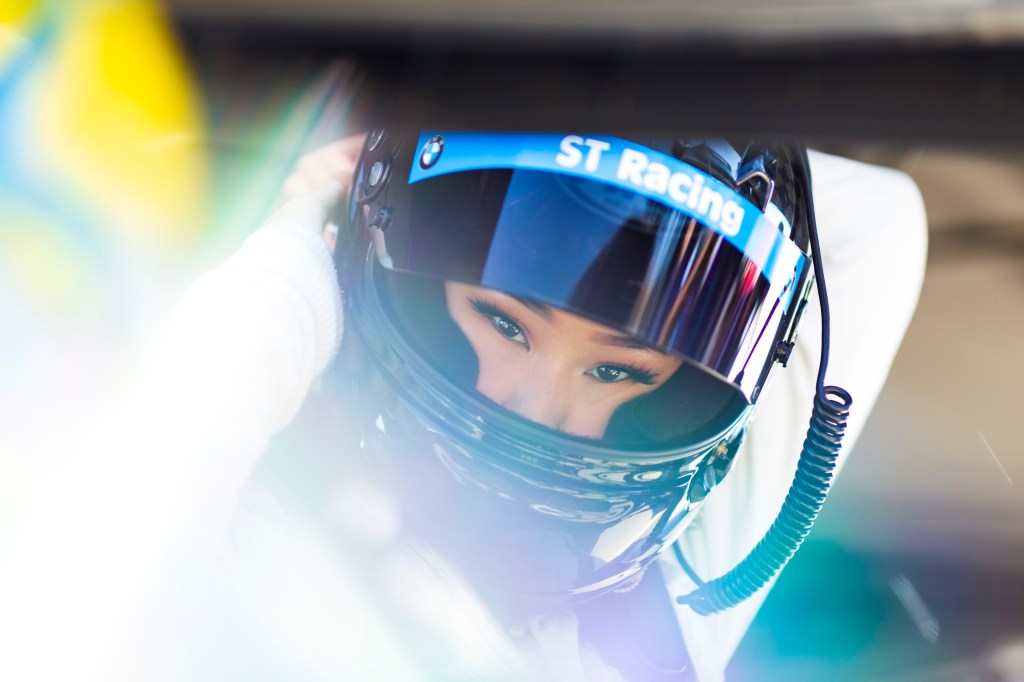
Photograph by Sean Krinik.
Part Two: The Career, Honestly
IRC: You co-founded ST Racing alongside your father when you were still a teenager, which means you’ve been building a business and competing at the same time for most of your career. What does running a team actually demand of you that nobody outside of it sees?
Samantha: One of the biggest misconceptions about running a racing team is that leadership always looks loud or centralized, where one person is seemingly controlling every moving piece. In reality, motorsport is far too complex for that. No successful team is built by a single individual.
To be completely honest, I never viewed myself as someone directly managing every operational aspect of ST Racing. From very early on, my father and I were intentional about surrounding ourselves with people who were more experienced, more technically knowledgeable, and more specialized in certain areas than we were. We learned quickly that building a strong team meant trusting others to excel in the roles they were best suited for.
I think one of the hardest lessons within that was learning how to delegate and relinquish control. Especially when something becomes deeply personal to you, there’s a temptation to try to oversee everything yourself. However, motorsport taught me that successful leadership often has less to do with personally carrying every responsibility and more to do with creating an environment where talented people can work together effectively.
To me, one of the most difficult, but also rewarding, aspects of building a team has always been the human side of it. Managing personalities, balancing opinions, maintaining morale, understanding how different people communicate, and figuring out how to maximize everyone’s strengths. Team synergy plays such a massive role in whether or not you succeed, especially in endurance racing where trust and collaboration are everything.
At the same time, I was also trying to develop as a driver. I always knew that my primary focus needed to remain on driving, improving my craft, and eventually building my personal platform and partnerships, which are such a critical part of sustaining a racing career financially. So for much of my career, I’ve existed in this intersection between athlete, entrepreneur, storyteller, and collaborator.
I think that balance is something people outside the sport rarely see. Racing drivers are often perceived only through the lens of performance on track, but behind the scenes there are constant conversations, relationships, strategic decisions, sponsorship responsibilities, and emotional investments happening simultaneously.
In many ways, building ST Racing taught me that motorsport is one of the purest forms of teamwork there is. No matter who stands on the podium, there are always countless people carrying that success together behind the scenes.
IRC: You’ve competed across GT4, GT3, the 24H Series, the Nürburgring 24 Hours, and made your Le Mans debut. Is there a series or a circuit that changed how you think about yourself as a driver?
Samantha: I think my 2024 GT World Challenge America season was the period that most fundamentally changed the way I viewed myself as a driver.
Not because it was the only season where I committed fully, I absolutely carried that same level of dedication into 2025, which ultimately led to my first GT3 championship title in IMSA VP Racing SportsCar Challenge, but because GTWC America pushed me to a level I had never experienced before. The competition was intense, and I felt like I had to fight for every tenth, every position, every result. That season demanded everything from me.
For the first time in my career, I truly felt like I was operating close to my full potential. I was completely locked in physically, mentally, and emotionally. Every session had intention behind it. Every detail mattered. I felt obsessive in the best possible way, constantly studying data, preparing, analyzing, and trying to maximize every opportunity to improve.
Because of that, I developed a kind of confidence I had honestly never experienced before. Not confidence rooted purely in results, but confidence built from knowing I had genuinely done everything I could. Even on weekends that didn’t go our way, I could still walk away feeling at peace because I knew I had fully committed myself to the process. There’s something incredibly freeing about reaching that point as an athlete.
By then, I had already raced across so many different championships, classes, cars, tracks, and environments around the world, and I finally felt like all of those years of experience were beginning to compound into something tangible. I was no longer just trying to survive at that level. I felt like I truly belonged there.
Even now, when I reflect on that season, I think what makes me most proud is not necessarily the podiums or wins, but what we built collectively as a team. That was the year where ST Racing truly felt like a factory-level operation to me. The professionalism, the preparation, the chemistry, the environment, everyone was operating at such a high level, and there was so much pride in what we had created together.
Which is also why losing the championship by a single point due to a mechanical failure was so devastating emotionally.
It hurt because so much had gone into that season from every single person involved. We had poured everything into it, and when you come that close after giving so much of yourself, the loss feels incredibly personal.
But strangely enough, I think that heartbreak also became part of why the season changed me so profoundly. It forced me to recognize that I was capable of competing at that level consistently, and that I belonged there. That even in disappointment, there was proof of growth.
That being said, racing at Le Mans impacted me in a completely different way. That experience honestly felt surreal, almost too difficult to process in real time. There are certain moments in life that feel so significant that your brain struggles to fully absorb them while they’re happening, and racing at Road to Le Mans felt like one of those moments for me. Even though I was not competing in the full 24-hour race itself, simply driving on that historic circuit carried an emotional weight I still struggle to articulate.
When you spend your entire life working toward something that once felt impossibly far away, finally arriving there creates a strange feeling. On one hand, there’s validation, proof that all the sacrifice, setbacks, and years of work meant something. But there’s also this overwhelming sense of gratitude and perspective. I remember having moments there where I almost had to step outside of myself just to fully take it in.
If I’m being honest, I don’t spend much time reflecting on my own career while I’m living it. Motorsport conditions you to immediately move onto the next race, the next goal, the next thing you still haven’t accomplished yet. It actually took this question for me to pause and realize how many extraordinary experiences I’ve already been fortunate enough to have.
Ultimately, I don’t think there was one singular race or series that changed how I see myself as a driver. I think it was the accumulation of years, the failures, podiums, victories, disappointments, lessons, and moments of perseverance, that slowly built that belief over time. Maybe that’s what growth as a driver actually is. Not one defining moment, but thousands of small moments slowly shaping the way you see yourself.
IRC: The 2017 crash at Pirelli World Challenge has become part of your public story, partly because of what came after. What was the actual lowest point, and what did it take to get out of it?
Samantha: I remember coming home after that crash and falling into one of the darkest mental spaces I had experienced up until that point in my life.
People often focus on the comeback because that’s the easier part of the story to tell. But the reality is that, in the immediate aftermath, I was consumed by self-hatred. I had sprained my ankle during the crash, and I remember lying in bed with my leg splinted and propped up on pillows, replaying the incident over and over again in my mind. I kept calling friends, asking them if they thought it was my fault, almost searching for someone to tell me it wasn’t.
At the time, I didn’t want to accept responsibility because accepting it felt intertwined with validating every cruel thing people were already saying about me online. When you are already fighting to prove that you belong in a space, making a public mistake feels catastrophic. It feels like confirmation for the people waiting for you to fail.
But eventually, I had to confront the truth honestly: I made the mistake. I was the one who crashed. Strangely enough, accepting that became the beginning of healing.
Once I stopped resisting the reality of it, I could finally put it into perspective. Every driver crashes at some point in their career. Motorsport is built around constantly searching for the limit, and sometimes, when you are chasing that edge, you cross it. That doesn’t make you incapable. It makes you human. It makes you a racing driver.
What ultimately pulled me out of that period was a combination of self-reflection, time, and the people around me. I definitely did not survive that experience alone. My support system carried me through a lot of moments where I genuinely struggled to see myself clearly.
But I also remember reaching a point where I made a very deliberate internal decision: I did not want to continue living inside that level of self-hatred anymore. I realized I had a choice. I could allow that moment to define me permanently, or I could learn from it, rebuild my confidence, and keep moving forward.
Looking back now, I think that experience forced me to develop resilience much earlier than I otherwise would have. It taught me that failure feels far less survivable when your self-worth is entirely tied to perfection. Part of growing from that moment was learning that mistakes, even painful public ones, do not diminish your humanity or your potential.
IRC: You’ve spoken about the double scrutiny of being a woman and Asian in this sport. Has that shifted at all over the years, or does it still show up in the same ways?
Samantha: The scrutiny has definitely shifted over the years, although I wouldn’t say it has disappeared entirely. When I first entered motorsport, there were so few women, especially Asian women, competing at this level that it often felt like any mistake I made became attached to my identity rather than simply being part of sport. Male drivers were allowed to just be drivers. But for women, or people of color, there was often this underlying feeling that you were somehow representing your entire demographic every time you stepped into the car.
However, I do think the landscape is slowly changing.
There is now female participation across virtually every role in motorsport. There are now female drivers, engineers, mechanics, strategists, team owners, media, and executives, and that visibility matters. The more normalized our presence becomes, the less people are able to reduce us to being “the exception.” I’ve also seen more diversity and inclusion initiatives being introduced across the industry, and more brands, teams, and media platforms intentionally highlighting underrepresented stories, like this piece itself.
The scrutiny still shows up online at times, and occasionally in person, but I think what’s changed most is that these conversations are no longer happening in silence. There’s more community, more support, and more people willing to challenge outdated perceptions of who belongs in this sport.
Honestly, I think that visibility creates a kind of momentum. Every woman or person of color who enters this industry and simply exists authentically within it makes it a little easier for the next person to imagine themselves here too. We are slowly reshaping what motorsport looks like, and because of that, reshaping who people believe motorsport is for.
IRC: BMW named you their first female POC GT3 team owner, and your goal is to be the first Asian woman to win Le Mans. What is a goal you’re chasing that nobody has attached a historic label to yet? Something that matters to you that isn’t about being “first”?
Samantha: I think one of the goals I care about most has nothing to do with being “the first” at all. It’s about helping open the door a little wider for the people coming after me.
Whether that’s through conversations, mentorship, introductions, creating opportunities, or simply helping someone feel like they belong in this world, I want to continue making motorsport feel more accessible for people trying to break into it.
Candidly, I think culture shifting is never the work of one singular person. It takes collective action. It takes visibility, community, advocacy, and generations of people continuously pushing things forward little by little. I’m only able to exist in the position I’m in today because of the people who came before me, whose shoulders I stand on now. People who challenged expectations long before I ever entered this industry.
Of course, there’s something incredibly special about making history. Being “the first” carries a certain weight and meaning, and I’ll never take that lightly. But I think what matters even more to me is making sure I’m not the last. I want there to be a next generation of girls, of Asian girls, of underrepresented kids entering motorsport who never have to spend years wondering whether there’s space for them here. I want them to arrive already believing they belong.
To me, that kind of legacy feels bigger than any singular milestone.
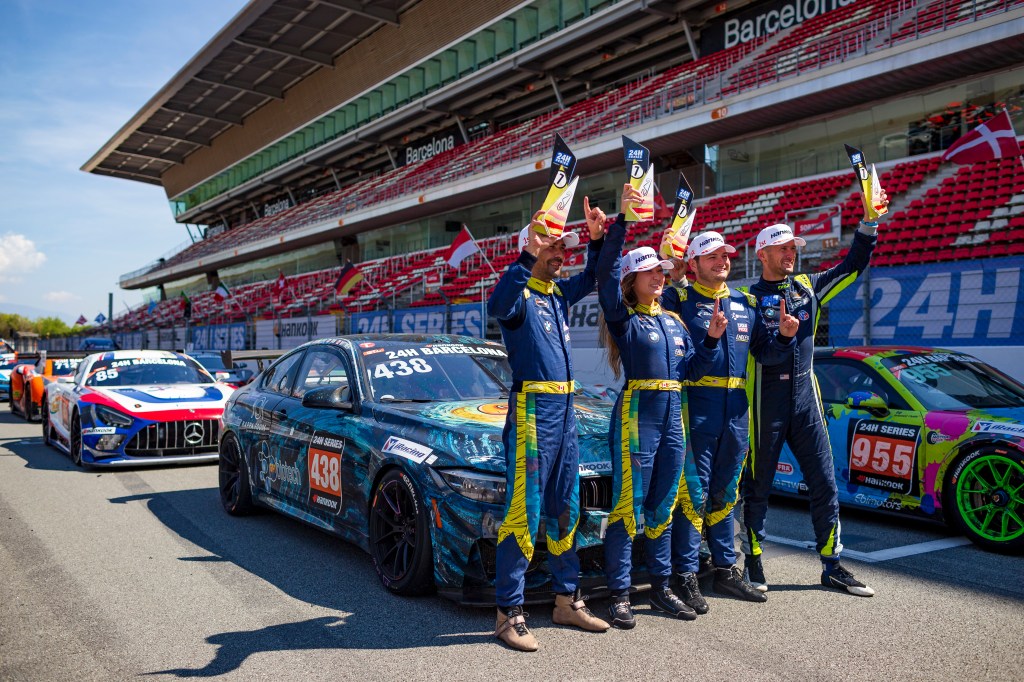
Photograph by Victor Chadarov.
Part Three: Community and What It Carries
IRC: Who has made you feel less alone in this sport? Is there a person, a community, or even just a conversation that helped carry you through a harder stretch?
Samantha: There are so many people who have made me feel less alone throughout this journey, and I know I wouldn’t be where I am today without the support system surrounding me.
My family has always been the foundation of that. My dad, my coach, my teammates over the years, my close friends at home, all of them carried me through different chapters of my career in different ways. I’m also incredibly close with my younger brother, and he has always been one of the people who keeps me grounded no matter what is happening professionally. Motorsport can become all-consuming very quickly, so having people in your life who remind you who you are outside of results is invaluable.
I’ve also been deeply inspired by the motorsport community itself, especially by the women entering the sport now. Seeing more girls pursue racing, engineering, media, leadership, and creative roles within motorsport genuinely gives me hope for what this industry is becoming.
One conversation that has stayed with me for years actually happened after my 2017 crash. I remember my coach telling me that I needed to get back into the race car as soon as possible, not recklessly, but intentionally, because if I waited too long, fear would begin to rewrite the narrative in my mind. He understood that I had to reclaim that experience before self-doubt consumed me completely.
I think about that conversation often, even outside of racing now. So much of growth in life comes from learning how to move forward before you fully feel ready. Confidence rarely arrives first. Sometimes you have to act before the confidence catches up.
Beyond motorsport, though, I’ve also found an incredible sense of connection and inspiration through the broader AAPI community over the past several years.
Growing up, I didn’t always feel represented, but I remember creators like Michelle Phan having such a profound impact on me during my teenage years. She almost felt like an internet older sister to me. Seeing someone who looked like me exist so confidently and creatively online made me feel seen in a way I didn’t fully know I needed at the time.
Today, being able to look at figures like Eileen Gu, Chloe Kim, and Alysa Liu, I feel such immense gratitude for the visibility and representation this next generation gets to grow up with. There is no shortage of brilliant, talented, multidimensional Asian women today who are authentically redefining what leadership, excellence, and individuality can look like.
I think that representation matters because it quietly expands people’s sense of possibility. Sometimes feeling less alone starts with simply seeing someone else exist unapologetically as themselves and realizing maybe you can too.
IRC: How have you found or built your own sense of belonging inside this sport, and what does that community actually look like in your daily life?
Samantha: Motorsport can feel incredibly isolating sometimes. For a very long time, I was one of the only Asian women competing at this level of the sport, and when you rarely see yourself reflected in the spaces around you, it can quietly make you question whether you truly belong there at all.
Ultimately, I think I had to build my own sense of belonging before I could ever expect to find it externally. A lot of that came from authentically pursuing my own path and refusing to shrink myself to fit into what this industry traditionally looked like. There’s a loneliness that comes with being “the first” or “the only,” but I never wanted that loneliness to harden me. I wanted it to become something hopeful instead.
In more recent years, I finally feel like I’ve begun to find community, not necessarily in one singular place, but in fragments across so many parts of my life. It’s in my social media community and the messages I receive from young girls who tell me they finally feel seen in motorsport. It’s in attending spaces like the Gold House Gold Gala or the Asian American Foundation summit and being surrounded by Asian creatives, founders, athletes, and storytellers who remind me how expansive and diverse our community really is. It’s in intentionally seeking out the women in the paddock on race weekends, or making new friendships with other girls at car meets, because those relationships didn’t naturally exist for me when I first entered this world.
I’ve realized community is something you often have to actively create when it doesn’t already exist for you. While I deeply believe belonging is something you ultimately give yourself, and not something another person or industry grants you permission to have, I also understand how transformative representation can be.
That’s what I hope we’re building now. Not just visibility, but a genuine sense of belonging for the next generation.
IRC: Do you feel the weight of being someone that younger women and girls of color look to as proof of what is possible? Does that ever feel like a burden as much as a purpose?
Samantha: Being viewed as a role model is both incredibly fulfilling and, at times, deeply daunting.
On one hand, it serves as a reminder of how far I’ve come, the barriers I’ve broken, the people I may have inspired, and the impact this journey has had beyond racing itself. I often speak about wanting to become the role model I never had growing up, and I genuinely try to hold myself to that standard in the way I carry myself, the way I speak, and the choices I make.
But at the same time, there are days when the weight of that responsibility feels incredibly heavy.
I think I place a tremendous amount of pressure on myself to always say the right thing, represent people well, and handle every situation perfectly. Sometimes it’s actually difficult for me to even fully accept seeing myself as a role model because there is still so much I want to accomplish. I catch myself comparing myself to the women I admire, or imagining this impossible standard of what the “perfect” role model should look like, and then feeling frustrated with myself whenever I fall short of that image.
I think some of that mindset is deeply tied to the way many of us within the Asian community are raised. There can be this underlying belief that no matter what you achieve, it is never quite enough. That there is always more you could be doing, more you could accomplish, more perfect you could become. I think I internalized a lot of that growing up.
Part of this journey has actually been learning how to accept myself more fully, not just as an athlete or public figure, but as a human being. Learning how to celebrate my own achievements instead of immediately minimizing them or moving onto the next goal.
Truthfully, representation does sometimes feel like a burden as much as it feels like a purpose.
When you are one of the first, or one of the few, there is this quiet pressure of feeling like you are setting the precedent for whoever comes after you. You become hyperaware of how your actions may shape people’s perceptions, not just of you individually, but of Asian women within the sport as a whole. There are moments where I’ve felt this overwhelming desire to “do it right,” to challenge stereotypes perfectly, to eradicate every outdated perception surrounding who belongs in motorsport. That weight can be really exhausting sometimes.
But despite that, I still believe the responsibility is worth carrying. I know what it felt like growing up without that representation. I know how powerful it can be for someone to see a version of themselves reflected in a space they once thought they could never belong in.
On the difficult days, I try to remind myself that perfection is not the goal. Humanity is, and maybe being a meaningful role model is less about never failing, and more about continuing to show up authentically despite the pressure.
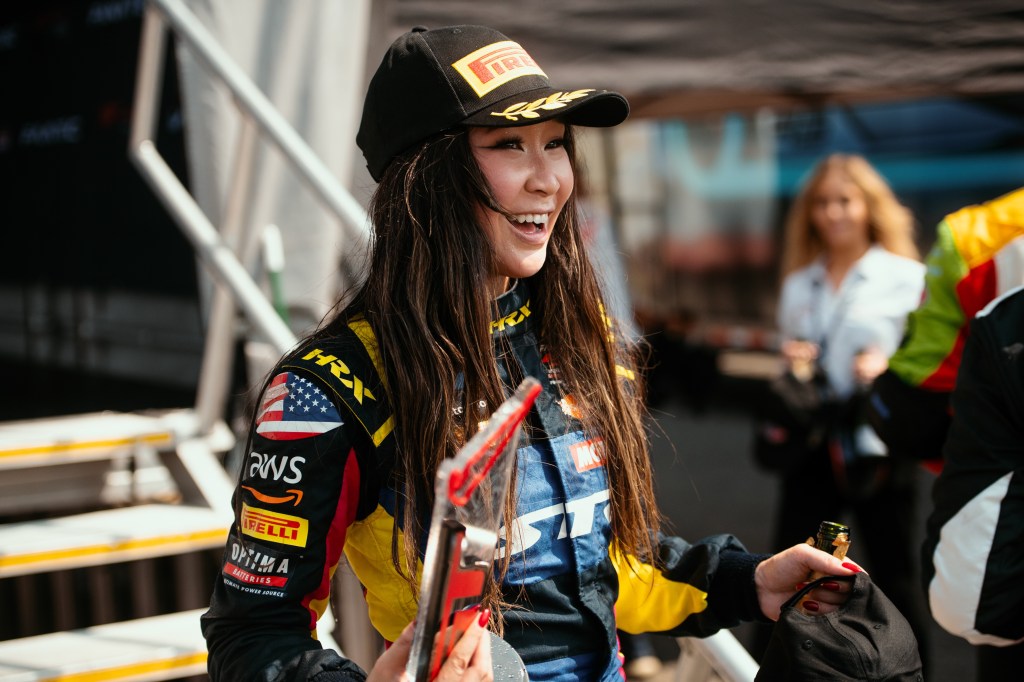
Photograph by George Bucur.
Part Four: Looking Forward
IRC: Winning the 24 Hours of Le Mans is the stated goal. What does the road between now and that start line look like?
Samantha: My perception of the road to winning Le Mans has fluctuated a lot over the past few years. There are moments where the dream feels incredibly close, like standing on the grid for Road to Le Mans last year and realizing I was finally racing on the same historic circuit I had spent my entire life dreaming about. Experiences like that make the goal feel tangible in a way that’s difficult to describe. For a brief moment, you almost feel like you can reach out and touch it.
But motorsport has a way of humbling you just as quickly.
Candidly, this current season almost did not happen for me despite how successful the previous two years had been. I had just won my first GT3 championship in IMSA VP Racing SportsCar Challenge, and our 2024 season had been incredibly strong competitively, yet even with those results, nothing was guaranteed moving forward. That is the reality of this sport. Performance alone does not secure opportunity. There is an enormous amount of work happening behind the scenes just to make it to the starting grid in the first place.
When I think about the road between now and Le Mans, I don’t necessarily view it as one singular leap. I see it as a series of smaller steps that all build upon one another.
The immediate goal for me is returning to a full GT3 campaign and continuing to rebuild the consistency, seat time, discipline, and racecraft required to compete successfully at the highest level of sportscar racing. From there, one of my major objectives is to compete full-time in IMSA WeatherTech and eventually pursue the Bob Akin Award, which secures an invitation to Le Mans. Realistically, I hope to achieve those milestones within the next three to five years.
At the same time, I think the landscape of motorsport is changing in ways that genuinely make me optimistic about the future. We are seeing tremendous growth across the industry, especially in the way brands are beginning to engage with motorsport. Partnerships that once would have seemed impossible are now becoming reality. I always point to partnerships like Sephora entering F1 Academy as such a groundbreaking moment because it demonstrated how much broader the audience and cultural relevance of motorsport has become. Furthermore, seeing companies like LVMH and Gucci entering the Formula 1 space signals an even larger cultural shift happening around the sport.
All of that gives me hope, because it expands what is possible for drivers like myself who have traditionally had to build careers through unconventional pathways and partnerships.
When I think about Le Mans now, I no longer view it purely as a distant dream. I see it as something very real, still difficult, still uncertain, still requiring an immense amount of work, but no longer impossible.
IRC: If a young Asian girl came to you and said she wanted to race professionally, what would you tell her that nobody told you?
Samantha: I think the first thing I would tell her is: don’t wait until you feel ready.
Confidence usually comes after you begin, not before. Motorsport can feel incredibly intimidating from the outside, especially when you don’t see many people who look like you within it, but everyone starts somewhere. Nobody enters this sport already fully formed, fearless, or certain of themselves. A lot of growth comes from simply having the courage to start before you feel completely prepared.
I would also tell her to focus on building both skills and relationships. Motorsport is such a collaborative industry. Whether you want to become a driver, engineer, strategist, mechanic, content creator, or work in marketing, success in this space is built through teamwork, curiosity, and community. Ask questions constantly. Learn from people around you. Surround yourself with individuals who both challenge and support you.
Most importantly, understand that there is no longer just one path into motorsport. That’s something I wish I had understood earlier. There are so many ways to contribute to this industry now and the sport is stronger because of that diversity of talent and perspective.
I would also tell her not to let labels define her. People will inevitably try to place you into certain boxes, because you’re a woman, because you’re young, because you look a certain way, because of your background. For a long time, I admittedly think I subconsciously tried to mold myself into what I thought would make other people most comfortable. I tried to minimize parts of myself in order to fit in more easily. But you do not need to conform in order to succeed.
You can forge your own path. You can be multidimensional. You can be ambitious, feminine, outspoken, creative, emotional, and competitive all at once. What ultimately matters is being undeniably committed to your craft, and that comes through hard work, discipline, and consistency.
Honestly, I would also tell her to be proud of herself for even wanting to step into a space where people like us have not always felt fully welcomed.
I think many of us, especially within Asian culture, are often taught to stay humble to the point of invisibility, to avoid taking up too much space, avoid confrontation, and avoid appearing overly proud of ourselves. But there is a difference between humility and shrinking yourself.
Altogether, I would tell her: celebrate your achievements loudly. Be proud of your identity. Allow yourself to be seen. You do not need permission to belong here.
A Note From Amanda
I knew Samantha Tan’s name before I knew her full story. She is the kind of athlete who accumulates headlines, titles, and historic firsts in ways that are easy to track on a results sheet. First female POC GT3 team owner for BMW. First GT3 championship. Road to Le Mans.
What the results sheet doesn’t capture is the version of Samantha who was in bed with her ankle splinted, calling friends to ask if it was her fault. Or the version who spent years quietly minimizing herself, making herself palatable, fitting whatever shape felt least threatening to the room she was in.
What moved me most about this conversation was her clarity about the difference between humility and shrinking. She lived that distinction for a long time before she could name it. And she named it here, directly, in a way I think a lot of us needed to read.
She still hasn’t figured out how to fully celebrate herself. She said so. But she’s working on it, which makes two of us.
Samantha, thank you for trusting us with your story.
— Amanda
Follow Samantha’s Journey across her platforms:
- Instagram: @samanthaatan and @samanthatanracing
- Website: st-racing.org
- Twitter/X: @str_samantha
- TikTok: @race.cat
- YouTube: Samantha Tan Racing
- Snapchat: @samantha.tan
- Facebook: STRSamantha
- Twitch: samanthatanracing
In Racing Color publishes interviews, profiles, and essays about the people who make motorsport what it is, with a focus on the voices that have long been overlooked. If you’d like to be featured, collaborate, or simply follow along, you’re in the right place. Find us at @inracingcolor on Instagram and Threads.


Leave a comment