
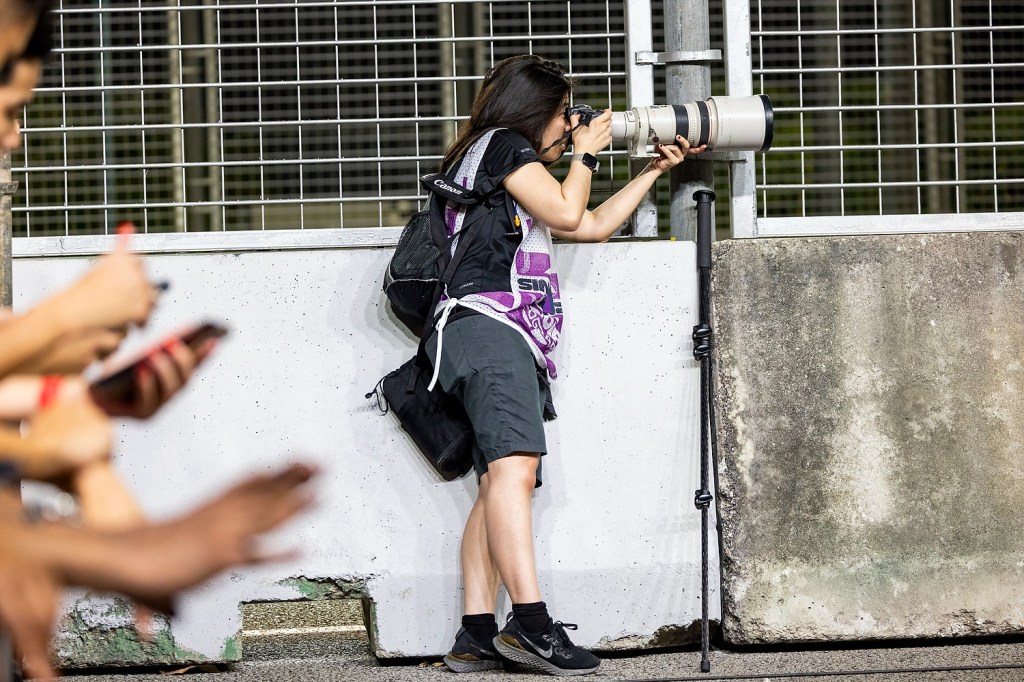
Photographer: Alvin Ho
The following interview was conducted in writing. All photos courtesy of Dawn Chua unless otherwise noted.
Dawn Chua has been a photographer since before most people decide what they want to be. She picked up her first camera as a child in Singapore, started shooting professionally at fifteen, and was covering major music festivals by nineteen. She trained in fine art at LASALLE College of the Arts and then at Goldsmiths in London, two schools, two cities, two very different ways of seeing. Now she shoots Formula 1.
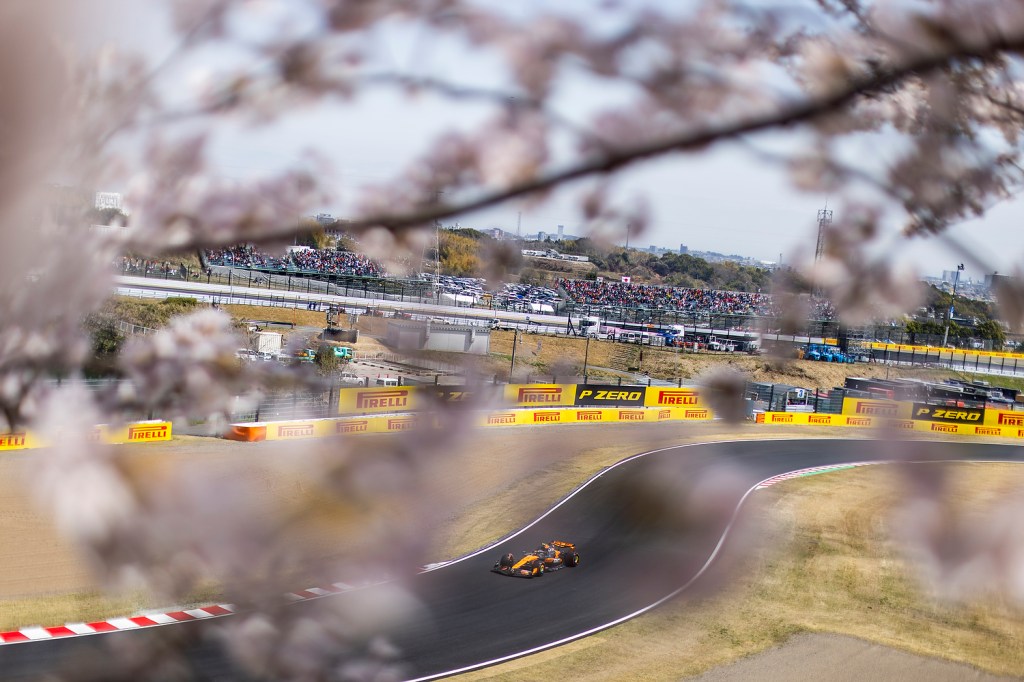
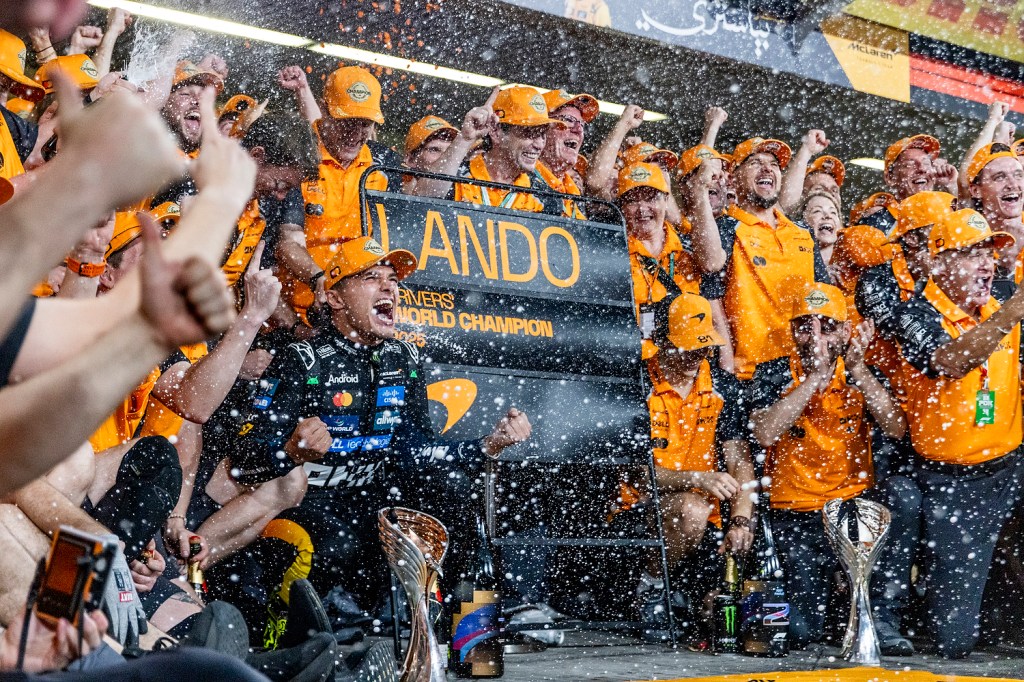
Her 2025 season took her to Japan, Belgium, Singapore, Qatar, and Abu Dhabi. Her bylines have appeared in Reuters, which was then used with the BBC, ABC News, and RTL Germany. She was in Abu Dhabi when Lando Norris won his first world championship, and the frame she made of the champagne celebration afterward is one of her favorites.
She still doesn’t feel like she’s arrived. She says to check back in a few years.
This is her story.
Part One: Who You Are and How You Got Here
IRC: Before we get into the cameras and the circuits, tell us who Dawn is outside of all of it. What does your life in Singapore look like?
Dawn: I’m quite a homebody as of late. I go running a lot. I love video games, Pokemon GO, Call of Duty, things like that. I spend time with my family, friends, and my dog. I’m into street fashion, nerd culture, music, and art, and I occasionally watch pro wrestling. I guess you can say my outlook on life is quite varied and colourful, and I indirectly take that into my work.
IRC: You trained in fine art at LASALLE and then studied media and communications at Goldsmiths in London. How did those experiences shape the way you see and photograph the world?
Dawn: London changed my life. I left my heart there and hopefully I can move back at some point. You can be whoever you want to be in London, and I really like that. The photography department at Goldsmiths is incredible and I still think a lot about what I learnt there. LASALLE gave me a lot of time to explore things. I was seventeen when I enrolled and already working as a photographer then.
My shooting style is fairly eclectic and I lean towards the artier side of things, I guess. I don’t know if there’s anything fairly specific that I took from my schooling, maybe a love for vibrant colours and deep contrasts, but I do want to put my own spin on things as much as I can, to show people the way I see motorsport and F1, and why I love it as much as I do.
IRC: As an Asian woman working in F1, a world that is still overwhelmingly white and male in terms of who holds the cameras, what has your experience of belonging or not belonging in that space actually felt like?
Dawn: I suffered from imposter syndrome for a very long time and kept to myself a lot. It took me a long time to come out of my shell. I prefer keeping my head down and letting my work speak for itself, but I’ve learnt that getting to know other people is essential. I am actually very shy outside of the paddock, though F1 does force me, in a nice way, to be a lot more outgoing than I usually am.
I am immensely lucky that the good experiences have vastly outweighed the bad. It’s there, of course, mostly in the form of microaggressions, but you learn to deal with it. I’ve been dealing with it since I started in music photography as a teenager, so I’m fairly used to it.
What I do love about F1 is that it’s hyper competitive from the top down. We all want to do better than others and get the shot that no one else has, and I enjoy being pushed in that environment. But I am incredibly fortunate that quite a few of the senior guys have looked out for me and shown me the ropes. I have learnt so much from them.
Part Two: The Work and What It Demands
IRC: What made Formula 1 specifically something you kept coming back to? Was there a moment, a frame, a race weekend that locked you in?
Dawn: It’s hard to rank because I’ve learnt from every weekend I’ve been in the paddock. The two that stand out the most were Singapore 2024 and Abu Dhabi 2025.
Singapore 2024 was the year things really clicked for me. I mentioned that I’m usually quite reserved, but that was the race that really brought me out of my shell. 2024 was overall a year of massive highs and lows for me personally, so I look back on that race with a lot of positivity.
Abu Dhabi 2025 was important because I have always wanted to photograph a driver winning a world championship. It’s been my goal from the very beginning of my career. And the champagne celebration shot I made of Lando and the team afterwards is one of my favourites.
IRC: F1 race weekends are physically and mentally relentless. What does a weekend actually feel like from your side of the lens, and how do you take care of yourself when the days get long?
Dawn: Twelve to fourteen hour days aren’t uncommon. I like getting in early, so sometimes I’ll arrive at 8am and leave at 11pm. Travel times to the track can be long as well. During the Japanese Grand Prix, I was on a train for close to two hours each way, every day. We also clock 15,000 to 25,000 steps a day carrying a lot of gear, so you have to be fairly physically fit to keep up. There is a lot of expectation, both from clients and from myself, to deliver the best work possible, and it’s really on me to keep going under that pressure.
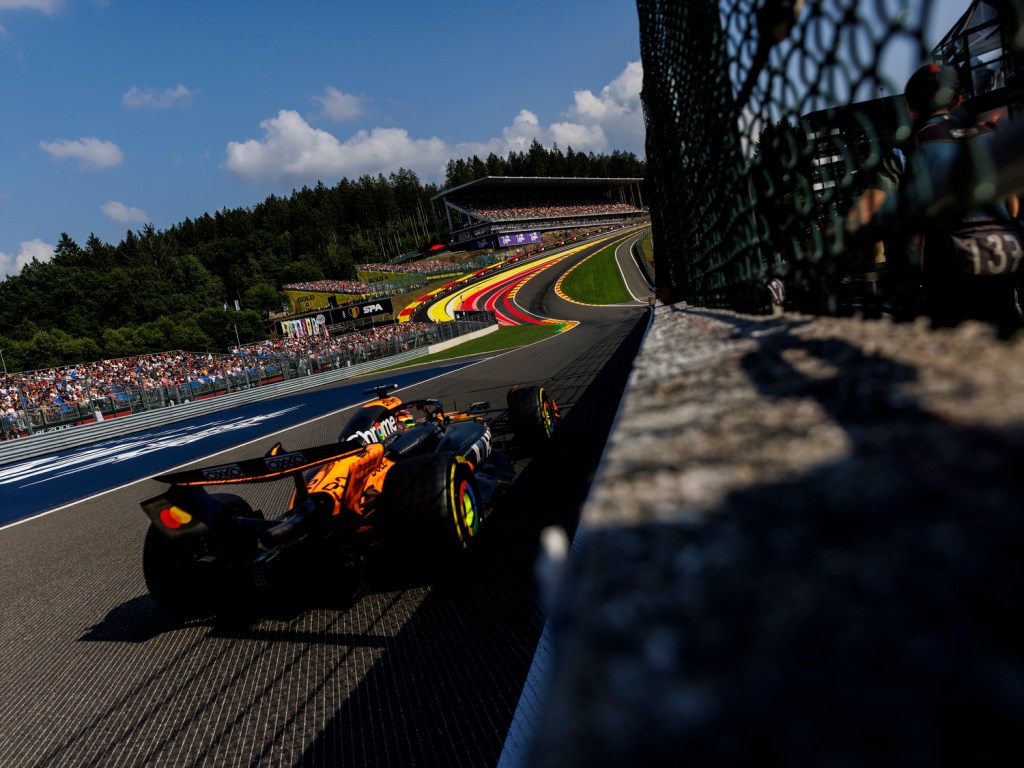
Running helps a lot. I try to get in a track run on Saturday night. One of my colleagues says he’s always baffled by my decisions because we’re already averaging 20,000 steps a day and yet I still decide to go running up Eau Rouge after qualifying. Frankly, I don’t know where that energy comes from either, but I’m not going to question it. Running really does help me let off steam.
IRC: Your 2025 season took you to Japan, Belgium, Singapore, Qatar, and Abu Dhabi. What is it like to shoot a race in your home city? Does the Singapore Grand Prix feel different from anywhere else on the calendar?
Dawn: I’ve been going to the Singapore Grand Prix since 2012, but before that I spent my teen years around that area, Sector 2 and 3 to give a better idea. I went to a lot of concerts at the Esplanade. They were one of my clients for a while, and I got my first break in their young photographer program in 2011. I’ve laughed, cried, and done a lot of growing up around those places, so yeah, it means a lot to capture those same roads when it’s race week. Your home race is always the best race, really.
IRC: Your general news reporting work has been published by Reuters and then was picked up by the BBC, ABC News, and RTL Germany. Was there a point where you felt like you had genuinely arrived in this space?
Dawn: I still don’t feel like I’ve arrived at all, so please check back in with me in a few years to see if there are any updates.
It’s always a rush to see that byline. I discovered once that my photos had appeared in some smaller European publications, and when I translated one of the articles I saw that one of them had marked my photo as “photo of the day.” That was really nice. Another time, my photo was used on the front page of the Straits Times, Singapore’s biggest national newspaper. I think my mom and dad were pretty proud of me.
Part Three: What You Wish You Had Known
IRC: If you could go back and sit with the version of yourself just starting out, what would you tell her? Not about technique, but about the industry and how to move through spaces that weren’t built with someone like you in mind.
Dawn: I think I’d tell her to keep her head down and pick her battles carefully. Always say thank you to the people who care for you. Then I’d tell her to enjoy the ride. That’s something I still struggle with. But I truly believe that if I’d started this part of my career earlier in my life, I wouldn’t have been able to handle it the way I do now. That came with age and time.
IRC: What do you know now about the business and culture of sports photography that you wish someone had told you before your first assignment?
Dawn: I think I’m still learning it all. Like any other area of photography, it is really competitive. I am incredibly fortunate to have some of the senior guys give me good advice. It is tough navigating the financial side of things and thinking about career moves. To be honest, it still stresses me out, but you have to keep faith and move with purpose in hopes that things will work out.
Photographer: Andrew Hone
Part Four: Community, Visibility, and What Comes Next
IRC: Visibility matters enormously to In Racing Color. The idea that a young Singaporean girl might see your byline on a Reuters wire image and think “that could be me” is exactly why this platform exists. Do you feel the weight of that visibility?
Dawn: Maybe in Singapore I felt that a bit in the local music scene. I started shooting professionally when I was fifteen, and by the time I was nineteen I was covering big festivals. That had more of an effect on me because I quite literally did my growing up, blunders and all, in front of so many industry people. It’s been a boon and a bane in so many ways. I still find myself second-guessing my decisions quite a bit, actually.
As for the F1 side of things, I really don’t think I’m influential at all. Photographers like Anni Graf or Lydia Harper are more visible in that space, and I admire them for it. I do get messages occasionally from younger people on social media and I’m very flattered.
When I was younger, I looked up to British photographer Emily Davenport. I remember thinking, “okay, she’s made a career out of this, so can I.” There’s also Cherry Fan, another female Chinese photographer working in the sport who I really admire. If I can be the person that Emily and Cherry were to me when I was younger, if I could be that someone to someone else, yeah, I’d be really honoured.
IRC: What does community mean to you in the context of this work? And what do you think the world of sports photography owes to the people who are still trying to find their way in?
Dawn: Some of the senior guys like Andy Hone, Luis Vasconcelos, Jack Ke, Frankie Mao, and Michael Potts. I’m indebted to them for life. Then there are people like Vladimir Rys and Darren Heath. I’ve admired their work for a long time, so to have them welcome me into the fold is something I don’t take lightly. Going toe to toe with some of the best motorsport photographers in the world really sets the bar high for me, and I appreciate having that challenge.
I think there could be more initiatives in F1 for young media professionals in general, but I don’t know who could provide that opportunity. It’s very saturated already. But if I do get to the point in my career where I can help with that, I’d love to give back and help lower the ladder for other women to climb up with me. I don’t know how I’d do it, but it’s something I’d like to do if I can.
A Note From Amanda
I knew Dawn’s photos before I knew her name. That’s how it tends to work with the best photographers: you recognize the eye before you learn who is behind it.
What I loved learning the most was the combination of things Dawn holds at once. She is shy yet also undeniably present in one of the most competitive environments in sports. She has published with Reuters and still doesn’t feel like she’s arrived. She talks about the microaggressions the way you talk about the weather, something you learn to dress for, not something that stops you from going outside.
Dawn didn’t frame herself as a role model. She framed it as a debt she hopes to pay forward someday, if she can, when she gets there. She hasn’t stopped to claim that she’s there yet.
She is, though. The front page of the Straits Times and the champagne at Abu Dhabi say so, even if she won’t.
Dawn, thank you for sharing your world with us.
— Amanda
Follow Dawn’s work on Instagram at @echoroar and explore her editorial and commercial portfolio at Echo Roar.
In Racing Color publishes interviews, profiles, and essays about the people who make motorsport what it is, with a focus on the voices that have long been overlooked. If you’d like to be featured, collaborate, or simply follow along, you’re in the right place. Find us at @inracingcolor on Instagram and Threads.


Leave a comment