
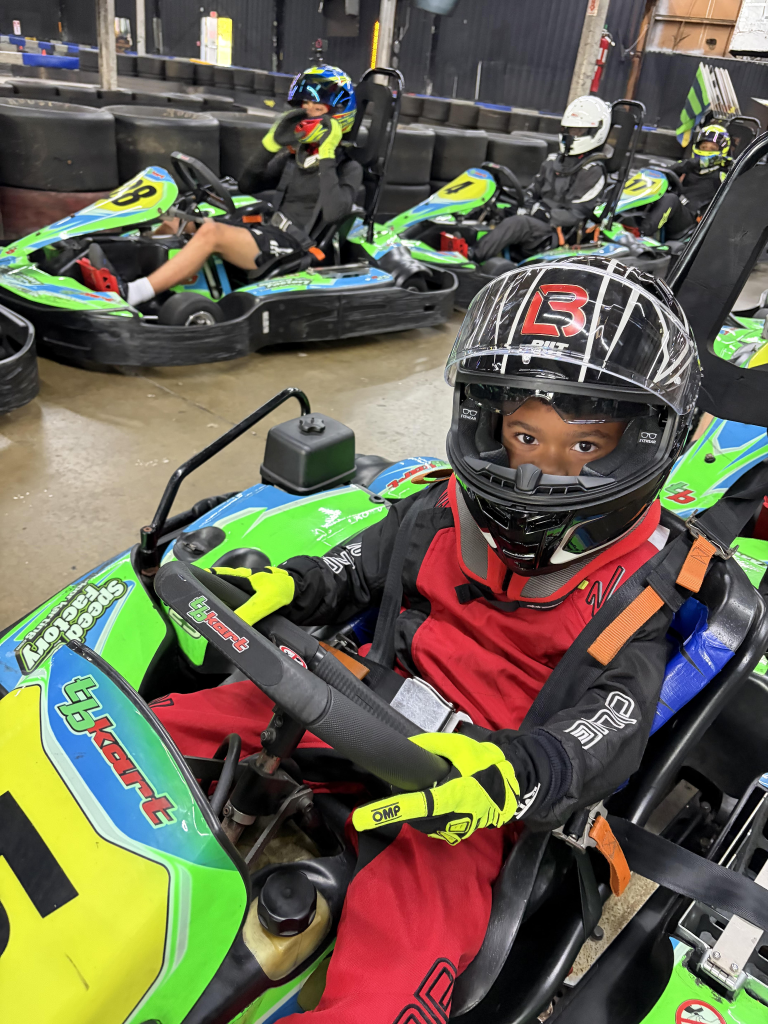
The following interview was conducted in writing. Responses from Landon Batson and his father, Dameron Batson, are attributed separately throughout. All photos courtesy of the Batson family.
Landon Batson was six years old when he watched Formula 1 with his dad and decided that was what he wanted to do with his life. A month later, he was on track at Victory Lane Karting in Charlotte, North Carolina. Eight months after that, he was racing adult karts against drivers twice his age at Speed Factory, running 70 pounds of ballast at race weight and logging simulator sessions every day.
He is seven years old.
His family is treating this like the career it is. His dad, Dameron, has done the research, built the schedule, found the competition, and instilled in Landon the belief that if he works hard enough, he can be one of the best in the world. In a sport that has seen exactly one Black driver compete at the Formula 1 level in its entire history, the Batson family is clear-eyed about what they’re building and why it matters.
This is their story.
Part One: The Beginning
IRC: Landon, you started karting in January 2025 at Victory Lane Karting in Charlotte. What was that first time on the track like for you? Did you know right away that racing was something you wanted to keep doing?
Landon: Yes, my dad was watching F1 and I got addicted.
Dameron: He was very slow his first lap, even in a youth kart. His lap time was a 96-something. But a few sessions later he was in the 44s. After he got the feel, it was over.
IRC: What made karting the right starting point for Landon’s journey, and how did you go about finding your footing in a sport that can feel unfamiliar to navigate from the outside?
Dameron: Early on, Landon decided F1 was the ultimate goal. So after a quick conversation with ChatGPT, it became apparent that karting was the next step. Finding our footing has been made easier by some parents and sources we have met along the way, and obviously, the internet. I think the sport is much more accessible than many think today, and I would encourage anyone curious to try out their local track to see if it’s their thing.
Part Two: Racing with Purpose
IRC: Lewis Hamilton is the only Black driver to have ever competed in Formula 1. When Landon says he wants to be an F1 driver, what does that mean to your family, knowing the specific history and weight of that goal?
Dameron: For my wife and I, the weight of what he is chasing is something we are aware of every time we post him or put him on track. Comments constantly compare him and tag Lewis, so Lewis and his dad are a major inspiration for all of us. We hope that Landon can be the next in a long list of drivers who inspire those who look like him.
IRC: Representation in motorsport is still limited, but it is clearly something your family thinks about intentionally. How does Landon understand his identity as a young Black racer, and has that awareness shaped your approach to his development?
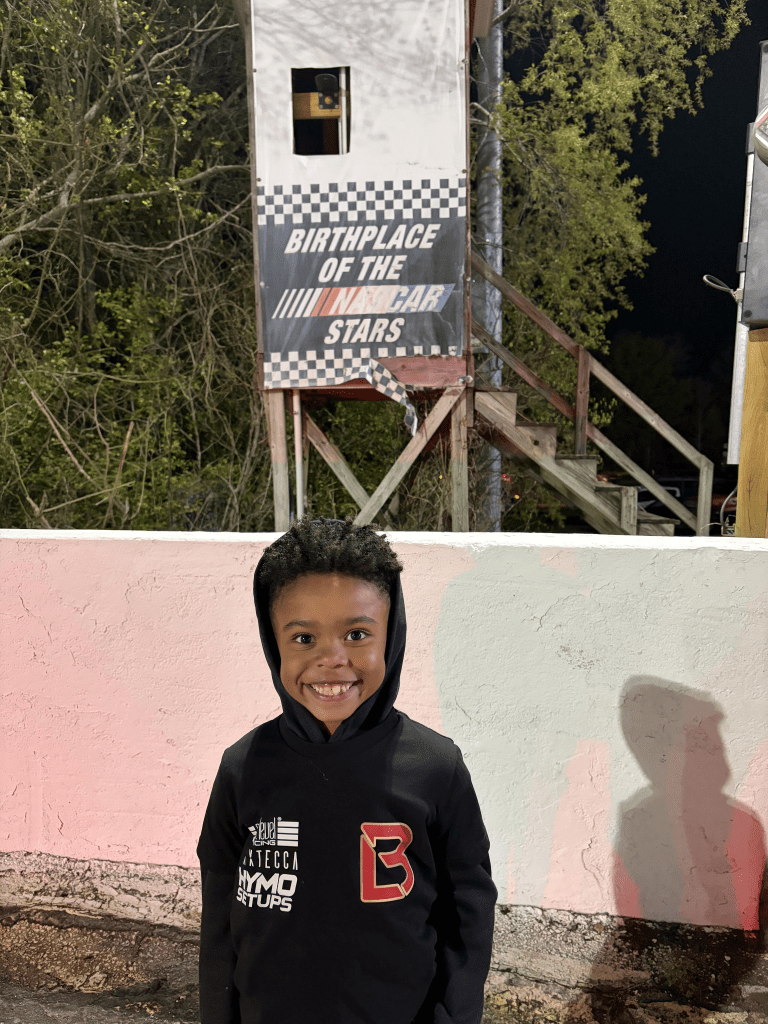
Dameron: Being that he is so young, his race and cultural background aren’t something we call attention to in our conversations with him. That being said, we attended and were welcomed into the pits by Dystany Spurlock, the first Black woman to race in NASCAR. That was a few weeks ago, and that’s probably the first time he noticed how much being Black makes him unique and a pioneer in this space. Our family is unapologetically Black, much like Lewis, and we hope our journey encourages others to be authentically themselves in motorsport.
IRC: What has it been like for Landon stepping into spaces, whether at the track or in competition, where he may be one of the only Black drivers in the room?
Dameron: He’s a chameleon, so he fits in anywhere. But we have been blessed to connect with a few drivers of color. He is the only in most rooms, and also the youngest. We would say he carries himself with ultimate confidence. He backs down from no one, no matter the age or experience. We fill him with the belief that he will be one of the best ever if he works hard, and that shows up on race day.
Part Three: Leveling Up
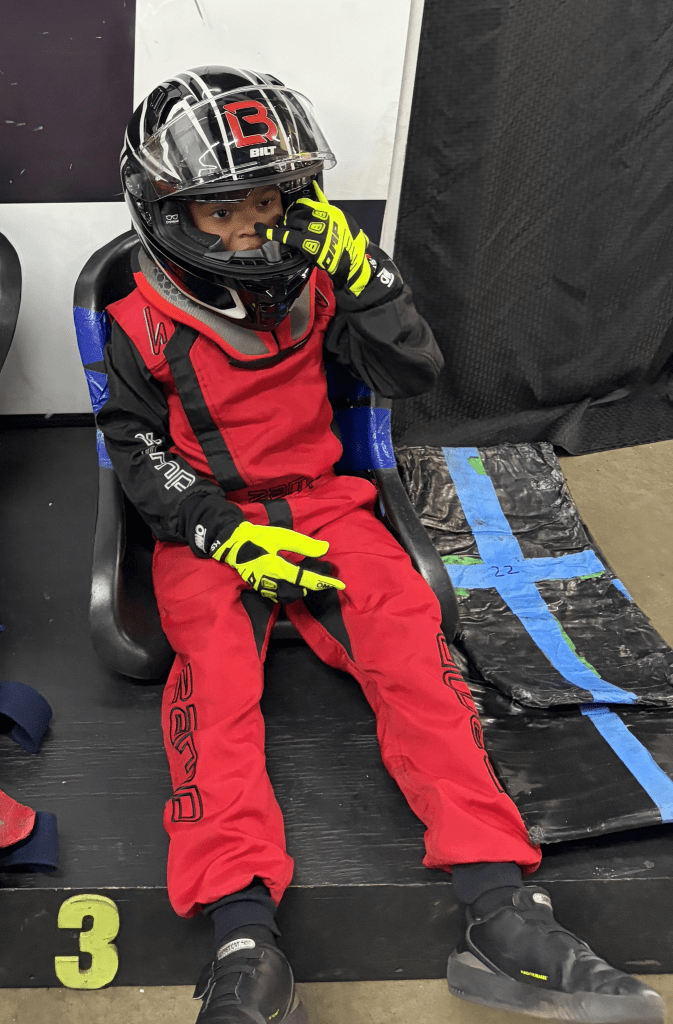
IRC: In September 2025, Landon made the jump to adult karts at Speed Factory, competing against faster and more experienced drivers. That’s a significant ask of a seven-year-old. What went into that decision, and what did Landon take away from that experience?
Dameron: Initially, we were taking him to Victory Lane Karting in Charlotte. However, the time commitment and format forced us to look for other options. A typical race day at VLK started at 4:30am for us in order to arrive for practice by 7am, and we would not get home until 5pm or later. All that for him to drive youth karts he could easily handle, in a qualifying system that punished fast drivers due to a convoluted structure.
The tipping point came during his first full season there. The field had expanded from around 20 drivers to upwards of 40. Management decided to put all the experienced and competitive drivers in the same qualifying heat. The way it works there: your qualifying heat finishing position determines your main race placement. Top 3 go to Main A, next 3 to Main B, and so on. By the time we got to Landon’s main race, he started 6th behind five drivers he was faster than by two to three full seconds. That was the impetus for trying Speed Factory. We took him the next day and that was history. He enjoyed the increased speed and competition, even though he wore down a lot faster. Ultimately, the time saved, the local location, and the more intense competition pushed the change.
IRC: Landon is now preparing for the American Rental Karting Championship. What does a typical week of preparation look like for him, balancing training, school, and everything else that comes with being seven?
Dameron: Race week starts on Sunday for us. He does three rounds at race weight, meaning 70 pounds of ballast added. He is homeschooled, always has been, so he gets schoolwork done during the day or at night, depending on the schedule. He won’t be in the physical kart again until practice on Friday, but he will be in the simulator for 60 to 90 minutes a day. Karate twice a week for strength and conditioning, with another small workout in between. Outside of that, he is reading Precision Racing by Jimmy Grills to understand the mechanics of going fast, and I race him on F1 25 for fun.
Part Four: The Road Ahead
IRC: You’ve described your mission as building something bigger than racing: creating visibility, belief, and opportunity for young Black drivers. What does it mean to Landon to know that his journey is being watched and documented, and that other kids might see themselves in him?
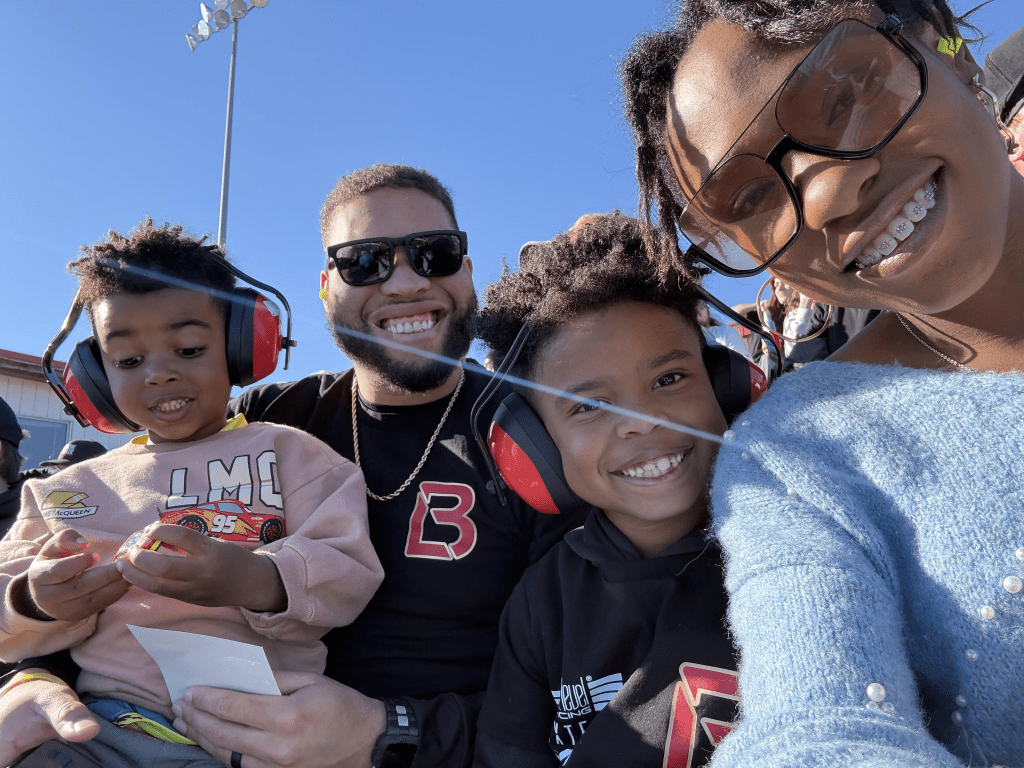
Dameron: A lot. Behind the scenes, there are tons of hard moments. Crashes that shake him up. Frustration with lap times and doubt in self. But knowing that 6,000-plus people already support him and are always in the comments with encouragement keeps him going. He’s climbing a mountain; he knows it, but everyone watching and being inspired, including his three-year-old brother, is a hand on his back pushing him up.
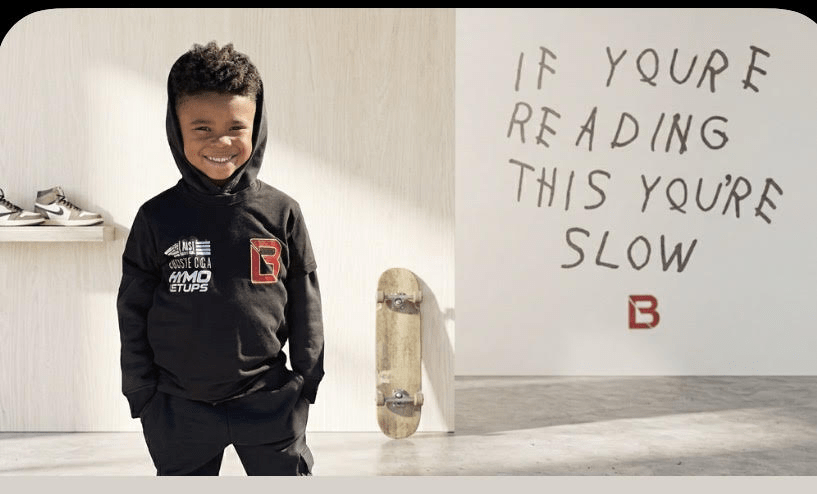
IRC: You recently launched Landon’s first merchandise drop to help fund his development. What has community support looked like at this early stage, and what do you want people to know about what it actually takes to build a path to professional racing?
Dameron: The community support has been unbelievable. We were worried no one would buy, that we would alienate his following somehow. But we have sold 98 shirts in two weeks. Huge thank you to everyone who is wearing the dream so far, including In Racing Color. The main thing we want people to know is that Landon is a professional now. We treat him as such on track and in the sim. That’s the only way he makes it to F1. So, to any sponsors or potential community members reading this: if you sign up to help, you aren’t playing pretend with a seven-year-old. You are investing in the future of motorsport.
IRC: When Landon pictures himself in Formula 1 someday, what does he see? And for the family: what is the one thing you hope people take away from following his story right now, at this very beginning?
Landon: I see me driving a Mercedes, Red Bull, or Ferrari. I see me winning a 9th championship at Monaco, Abu Dhabi, or Hungary. I see me winning hard races like Jeddah and Monaco. I see me as a nine-time world champion.
Dameron: There are only 22 seats in F1. It’s a nearly impossible dream. But we challenge people to dream anyway.
A Note From Amanda
I came into this interview knowing Landon from his corner of the internet, where a seven-year-old in a kart had already built a following of thousands by simply being undeniable.
What stayed with me after reading their answers is something Dameron said about the hard moments. Behind the posts, behind the lap times and the merch drops and the simulator sessions, there are crashes that shake him up and doubt that creeps in. A seven-year-old sitting with the weight of a dream that big, in a sport that hasn’t seen many that look like him succeed.
Then, I think about what Landon said when I asked him what he sees when he pictures his future. Nine championships. Monaco. Jeddah. A Mercedes, a Red Bull, or a Ferrari. He didn’t hedge. He didn’t qualify it. He just told me what he sees.
There are only 22 seats in Formula 1. Dameron knows that. His wife knows that. They’re building toward it anyway, because the alternative is not building at all. That’s the thing IRC exists to document: not just who is already in the room, but who is on their way.
Landon is on his way.
Landon and Dameron, thank you for letting us in at the very beginning.
— Amanda
Follow Landon’s journey on Instagram and support his development by buying his merch.
In Racing Color publishes interviews, profiles, and essays about the people who make motorsport what it is, with a focus on the voices that have long been overlooked. If you’d like to be featured, collaborate, or simply follow along, you’re in the right place. Find us at @inracingcolor on Instagram and Threads.

 In Racing Color
Leave a comment